Ennio Morricone’s collaboration with director Giuseppe Tornatore on 1988’s Cinema Paradiso was one of the countless highlights of his career, and it’s Tornatore who has masterminded this sprawling documentary tribute to the composer, who died in July 2020.
Apparently it took him five globe-trotting years to amass interviews with a huge list of Morricone’s admirers and collaborators, so perhaps it’s no great surprise that he seems to have found editing his material into a manageable shape a daunting task.
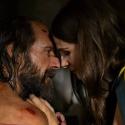
Tornatore’s decision to plough doggedly through Morricone’s career, from his days as a music student at Rome’s Saint Cecilia Conservatory through a period as a jobbing trumpeter working in clubs and theatres before he established himself as a world-famous composer, may also not have been such a great idea. It has trapped Tornatore on a chronological treadmill which obliges him to try to include everything Morricone ever did, rather than picking out the most significant milestones and building his narrative around those. Also the way some interviewees, such as The Clash’s Paul Simonon or Italian rock star Zucchero, pop up to deliver a solitary soundbite is confusing rather than enlightening. Even admiring comments from Bruce Springsteen convey the impression that they’re there because Springsteen is a big marquee name, not because he has anything especially insightful to say. Which isn’t to say that the film doesn’t have its strengths. Merely revisiting Morricone’s epic string of triumphs is a flabbergasting experience, from Sergio Leone’s Westerns – his music from Once Upon a Time in the West seems to become more overwhelming as time goes by – to Pontecorvo’s Battle of Algiers, Brian de Palma’s The Untouchables and Leone’s last hurrah, Once Upon a Time in America. There are insightful contributions from fellow film composers Hans Zimmer and John Williams – the latter observes that Morricone always had an instinct for what was appropriate for a particular scene, “but you can always tell it’s him from the first note”– while a roll-call of directors provide a variety of perspectives (pictured above, Morricone and Sergio Leone).
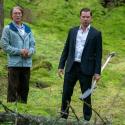
Roland Joffé, whose film The Mission prompted one of Morricone’s best-loved themes but controversially failed to win him an Oscar, describes how the maestro’s music “created a world that wasn’t quite on the screen”. The sentiment is echoed by Bertolucci, who says that Morricone’s music for his film 1900 “created a parallel movie”. Though the composer was awarded a special honorary Oscar in 2007, it wasn’t until he wrote the score for Quentin Tarantino’s The Hateful Eight in 2015 that he won one for a specific film (pictured below, Tarantino and Morricone). Perhaps his reluctance to leave Italy and become fully Hollywood-ised counted against him. Tarantino’s ecstatic rant to the Academy crowd about how Morricone can only be measured against the likes of Beethoven, Mozart and Schubert brought the laconic response from the maestro that in order to establish the truth of this, one would have to wait 200 years.
 The real gold-dust in Tornatore’s film is his own in-depth interview with Morricone, conducted over 11 days and roving across his entire career. The composer’s lucid and analytical insights into his work surpass anything anybody else has to offer, like his description of the double three-note chromatic clusters he used for action scenes in Battle of Algiers, or how he broke new conceptual ground with his arrangement of Mina’s 1966 Italian pop song "Se Telefonando" (this involved using three notes over a 4/4 rhythm, so the stress never falls on the same note).
A running theme is Morricone’s struggle to convince himself that writing film music wasn’t the poor relation to composing “absolute music” in the classical and academic tradition, something he continued to do even as he became one of the world’s most in-demand creators of film music. He’d visited Darmstadt, the home of avant-garde and contemporary classical music, and explored serialism and musique concrete, always considering himself an experimental composer as well as the creator of film soundtracks. But finally he came to believe that film music is “full-fledged contemporary music”. The enduring power of his work tells its own story.