Italy has a romance with rural grit and innocence and – perhaps not surprising in a country where the links between village and city are still very strong: Alice Rohrwacher’s Happy as Lazzaro (Lazzaro Felice) isn’t in any way derivative, but revisits some of the same territory as Olmi’s The Tree of Wooden Clogs (1978) and the Taviani Brothers’ Padre Padrone (1977) and Kaos (1984), all classics of the genre. These films share a worldview in which religious superstition, the cult of saints, a tradition of supernatural story-telling and the exploitation of the peasant class by the rich provide a fertile setting for an imaginative yet socially engaged cinema.
Rohrwacher’s follow-up to her Cannes Palme d’Or winner The Wonders (2014), tells the story of a childlike "saint", Lazzaro, a thoroughly good man, and his travels from country to city and through life, death and rebirth (as the New Testament Lazarus), and from one form of poverty and submission to another. Money and greed, in both rural and urban settings, provide a leitmotiv for daily life. Based on real events in the 1990s, the story starts in the hamlet of Inviolata – the name suggesting a kind of untouched paradise – where sharecroppers are exploited by a ruthless chain-smoking Marquise, for whom they gather tobacco leaves.
Rohrwacher evokes with great atmosphere the inbred culture of the clump of houses at the foot of the aristocrat’s crumbling mansion: an introverted community excluded from the modern world, where flights of the imagination take precedence over everyday reality, the moon speaks its own language, along with the wolf’s howls in the dark night. As the Marquise cynically remarks, alluding to the peasants who work for her while going hungry, “Human beings are like animals: set them free and they realise they are slaves, locked in their own misery. Right now, they suffer but they don’t know”.
 The blissful ignorance of Inviolata’s peasants is their saving grace, at least until they move to the city and discover that they’ve been the victims of a “Great Swindle”. Lazzaro is befriended by the Marquise’s rebel son, Tancredi, who proposes a pact to the boy, claiming him as his half-brother, as his father the Marquis took advantage of the young peasant women under his control. Tancredi is a dreamer and persuades Lazzaro that they have a mission as knights. Lazzaro slips on a rock and falls from a cliff-edge to his death.
He is miraculously reborn many years later when a wolf licks his face – and as we witness the rebirth, we become aware that Rohrwacher has deftly played with our capacity for imagination, by setting this magical event in the context of a tale that the peasant Antonia is telling her son Pippo. Throughout the film, we gradually realise, the film-maker plays with a number of story-telling layers, the boundaries of which are blurred, so that we become less and less sure of what is "real" or not.
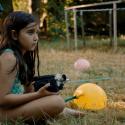
The best magical realism does just that: makes us dream and, in so doing, understand our rational and waking lives better. As a kind of post-modern folk-tale Rohrwacher’s film is often dazzling, with a variety of camera styles – hand-held and documentary-style at times and then grandiosely reminiscent of Dovzhenko’s hymns to peasant labour. But the central character of Lazzaro is a little one-dimensional, as if he were more of a vehicle for the film-maker’s imaginative leaps rather than a creature of flesh and blood. Incarnated by the disarmingly honest face of the actor Adriano Tardiolo (pictured above), Lazzaro is a folk tale hero, and as such a figment of the imagination rather than real character.
In the city, where Lazzaro returns as a kind of ghost, 20 odd years after his death, his now much older friends from Inviolata are crammed into an abandoned metallic tank next to a railway line. This is a dark story, reflecting the deep ambiguity of the human condition: generosity one minute and thievery the next. Curiously, for a film about a kind of rebellion, Rohrwacher has cast the police, who intervene twice in the film, the representatives of order, as wholly benevolent forces. Magical tale and social realism collide throughout, not always convincingly, and yet, flaws aside, this is cinema of great and welcome originality.