Any suggestion that the companion piece to director Joshua Oppenheimer’s The Act of Killing, his disturbing documentary on the state-supported mass killings undertaken for Indonesia’s Suharto regime, could actually be a more troubling film might seem surprising. The Act of Killing was extremely unnerving. The Look of Silence is even more distressing, even more frightening. Inong, a death-squad leader interviewed in the new film, chillingly says, “if we didn’t drink human blood, we would go crazy.”
This was the still-pumping blood of a dying person whose throat he had just cut. In the vocabulary of Inong, the meaning of the word "crazy" is so thoroughly distorted that the actions he undertook in 1965, when he was killing around 30 people a day, are less crazy than what he thought they might do to him. Sense has no place in a world of evil
If this implies that The Look of Silence is hard to watch, it is meant to. Do not think that having seen The Act of Killing is any preparation for The Look of Silence. This documentary has the potential to induce nausea. It is also, like The Act of Killing, landmark cinema.
 Where The Act of Killing focussed on the killers and their re-enactments of what they did, The Look of Silence looks at one case from the perspective of a victim’s family. As much a film about the nature of memory as it is about the recent history of Indonesia, the way it is underplayed is in keeping with how the aberrant has been both brushed under the carpet and rendered the stuff of the day-to-day.
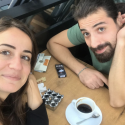
The Look of Silence centres on Adi (pictured above right), an optician in North Sumatra who goes to the homes of his clients. He is 44 years old and married with children. His mother (pictured below left with Adi) and father are still alive. Adi was born after his brother Ramli had been killed during the early days of the Suharto regime. It’s acknowledged that Adi was conceived to replace Ramli. The look of silence in the title describes Adi’s countenance while viewing Oppenheimer’s footage of those involved in and from the death squads on a TV screen. In the footage, he sees the killers of the brother he never met.
 Adi goes into the homes of the killers and those who facilitated his brother’s death to test their eyesight. Face-to-face with them, he helps the eyes which saw his brother killed to see better. He interacts with their relatives. His probing is calm. In all cases, they have no guilt as they were taking orders. At one point, he is told, “you ask too many questions”. He even finds that his uncle, his extremely elderly mother’s brother, was a guard at the prison camp from which Ramli was taken to be killed. Adi’s mother says she had no idea her brother was a prison guard. Those who eviscerated Ramli remember it, describing it in detail. One of the killers even had a home-made book with his own drawings showing how he killed Ramli.
What is said and what is explicitly described is horrible. The Look of Silence does not follow the approved Indonesian line – Adi’s son is seen at school being taught the official version of history.
The matter-of-fact presentation contrasts with The Act of Killing's surreal re-enactments. Homing in on the personal gives the film gives the film much of its impact. The Look of Silence confirms that Oppenheimer is a tremendously gifted director.
Much of the testimonial footage was filmed before the director had begun work on The Act of Killing. The two films tell aspects of the same story in very different ways, and one does not need to be seen to appreciate the other. See this masterpiece, but do so on the understanding that this powerful film is very distressing.
Overleaf: watch the trailer for The Look of Silence
Watch the trailer for The Look of Silence