There’s an admirable modesty in the way Jonah Hill has approached his first film as writer-director. The popular actor (Superbad, Moneyball, The Wolf of Wall Street) has taken a low-key indie approach to Mid90s, his gently humorous coming-of-age drama about a pint-sized 13-year-old, Stevie, who wills himself into a gang of older LA skateboarders. He’s played by Sunny Suljic, who’s as absorbed and absorbing here as he was in The Killing of a Sacred Deer.
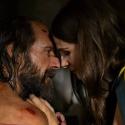
Stevie is an appealingly sweet kid with a big mop of hair and zero street wisdom. He’s first seen being beaten up by his older brother Ian (the excellent Lucas Hedges, pictured below left) in the passageway of the home they share with their single mom Dabney (Katherine Waterston). Too guarded even to thank Stevie for the DVD he gives him for his birthday, Ian reveals in a rare moment of intimacy that Dabney used to party hard, with boyfriends coming and going. Ian has repressed the shock of hearing moans coming through the wall; he's turned out a tightly-wound bully. Having avoided that Oedipal trauma, Stevie is an optimist, game for anything.
He needs acceptance, though, and a surrogate family. Bamboozled by their big boy talk, he starts hanging out with Fuckshit (Olan Prenatt), an androgynous stoner indebted to Fast Times at Ridgemont High’s Jeff Spiccoli; his more mature best friend, Ray (Na-kel Smith), an aspiring pro-skater; Fourth Grade (Ryder McLaughlin), a blond videographer named for his apparent dumbness; and Ruben (Gio Galicia), the gang’s previously youngest member. Initially an inept skater, Stevie toughs out his falls and is soon rolling along highways. Ruben gives Stevie his first cigarette and teaches him not to say thank you, because it’s “gay", but he resents Stevie’s quick promotion from inquisitive court jester to regular gang member. Nicknamed Sunburn following a chat about whether blacks like Ray get sunburns and a droll remark that erases racial difference, Stevie finds his stock rising higher when he cuts his head open after failing spectacularly at a dangerous skating stunt.
It rises even higher after pretty, knowing Estee (Alexa Demie), sensing Stevie hasn’t yet been hormonally warped and overlooking his shortness, takes him into a bedroom at a party and initiates him in foreplay. He boasts to his friends about what they did; she tells hers that he was “shaking", scarcely a betrayal given that she’s put a feather in his cap. Stevie suffers a few ups and downs, but he learns from Ray, who has suffered tragedy, that he is the kid in the gang with the least problems. Stevie’s crisis comes only from trusting his friends too much: they pile into Fuckshit’s car when he is too high and drunk to drive…
Shot cinéma vérité-style by Christopher Blauvelt, Mid90s matches its authentic look to the boys’ tumbling, post-hip hop dialogue, laced with inauthentic machismo (which Stevie can’t pull off). Having worked with Quentin Tarantino, Martin Scorsese, and the Coen Brothers, Hill could have been forgiven for putting on the ritz, but he indulges just one stylistic flourish: the use of jump cuts to rearrange the gatherings of the boys and girls at the party.
Mid90s is strongly analogous to Catherine Hardwicke’s Thirteen and especially last year's Skate Kitchen, written and directed by Crystal Moselle. Like the latter film, with which it would make a compelling double bill, it avoids a rigorous structure, developing the increasingly confident Stevie’s journey through a relaxed succession of incidents – fly-on-the-wall bonding sessions, skate park sequences – peppered with irruptions of minor violence. Hill has a future as a filmmaker, and it’ll be interesting to see if he stays in indie mode or next time goes more Hollywood.