There’s a rich seam of folk stories about changelings, infants snatched from home and replaced with a substitute child, to the horror and bewilderment of their parents. The myth taps into parental anxieties that rear up when their offspring doesn’t resemble them. Harsh rejection of this seemingly alien being, who has usurped the place of a beloved child and threatens family harmony, is traumatic.
We don’t see the moment when Eugenia (Patricia Clarkson) told one of her two sons that she can no longer be their mother. That denunciation happened long before the film begins, when Monica (Trace Lysette) came out as trans. But that primal rejection echoes through this long, slow drama that sees Monica returning to her childhood home decades later in order to care for her mother, who is dying of a brain tumour and seemingly doesn’t recognise her.
In her absence from the family home, Monica’s brother Paul (Joshua Close) has had three children with Laura (Emily Browning). It’s Laura who contacted Monica, convinced that the sister-in-law she’s never met, should be given the chance to spend time with her dying mother. Cue awkward reconciliations between the estranged siblings and many tender moments when Monica cuddles her niece and baby nephew. Everyone is in on the deception, including a kindly housekeeper with her own troubled son.
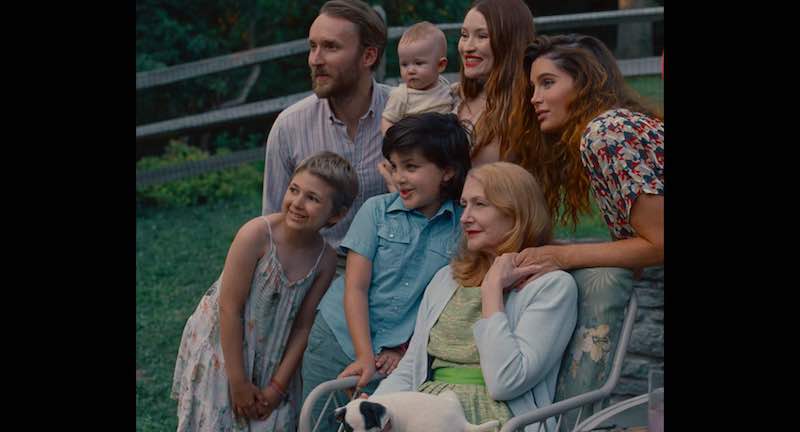 Stylistically, Monica is the very opposite of a melodrama; it’s a film of minimal dialogue, replete with static, boxily framed scenes in which not a lot happens, while we are encouraged to imagine the thoughts playing out behind Monica’s cat-like eyes. But as she tends lovingly to her mother’s body, helping her out of a bath, stroking her back and putting on fresh lipstick, I couldn’t help thinking of the Victorian melodrama East Lynne with its notorious line “Dead, dead and never called me mother!” Monica is almost a perfect reversal of that tortured tale in which a disgraced divorcee disguises herself in order to become governess to the children she abandoned only to have one of them die. I found myself wondering at what point in this languorous movie would Eugenia look at this palliative care aide who has appeared mysteriously in her home, and see beyond the feminised nose, the voluptuous, sculpted body and finally recognise her rejected son?
That showdown never quite comes, instead we get snatches of the life Monica has led since she left her Oregon home for California. There are angry, tearful voicemails to an ex-boyfriend who no longer returns her calls; glimpses of her work as a masseuse, tapering into sex-cam sessions. We witness a joyless fuck in the cabin of a trucker picked up at a local bar, after the man she wanted to date has stood her up. It’s not exactly a positive representation of trans life.
While one admires Trace Lysette’s subtle, low-key performance – this is her first leading role in a film having come to fame as Shea in the television drama Transparent – it’s hard not to wish that occasionally some sparks would fly. Writer-director Andrea Pallaoro has crafted a movie very much designed for admiration at film festivals and a limited art house audience.
Style is all, with a restricted palette of blues and oranges, tightly cropped frames in which characters talk to each other while all we see are their backs. Scenes are played out at length with the director seemingly convinced that leaving the camera running on a pensive face is the height of profundity. If you’re curious about the challenges trans people can face with their families, you’d be better off waiting for the far more engaging and unpredictable British film, Unicorns, that’s due out next year or tracking down Kokomo City or Joyland.