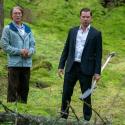
An old woman, inexplicably known as Granny Four, is murdered by a river on the outskirts of a Chinese rural town. A respected detective is put in charge of the investigation, with the weight of his department’s reputation on his shoulders. But this a murky, twisty case that opens and closes with such regularity that it begins to threaten the man’s sanity.
Adapted from a short story, on the surface Wei Shujun’s film is a combination of police procedural with film noir, shot with flair and imagination, and imbued with an offbeat sense of humour and appropriately downbeat sensibility. Yet there’s another aspect, a psychological undercurrent, which becomes stronger as the film progresses and, slowly and determinedly, throws the film off course; while this may well have been Wei’s intention, to play with genre conventions, he threatens to sink his efforts altogether.
It does starts incredibly well, though. A fantastic opening sequence follows a young boy playing inside an empty apartment building. The lad is wearing a Teamsters jacket, of all things, covered by a transparent rain mac that adds a frisson of Patrick Bateman, and holds a toy pistol, searching empty rooms as though he’s a cop. Then, as he throws open one door, it’s into a void – we see that the building is derelict, cut in half, the boy staring into a rain-drenched, hellish urban landscape.
 The lad will feature, with some pathos, in the story that follows, as does this muted, grainy, rainy mood, the weather beating down with the oppressiveness it had in Seven, every building a wreck, people living in cramped squalor. The 90s period setting and undernourished rural milieu also adds a pronounced low-tech air to the police investigation (it’s fun to see a cassette recorder as integral to chasing down a clue). Life seems miserable and forgotten enough, here, for murder to make much of an impression.
In keeping with all this, the police force is experiencing pressure, and cuts; so when the police chief learns that a cinema is laying empty and unused, he moves his detectives into the building. And it’s from here that his star detective, Ma Zhe (Zhu Yilong), leads the murder investigation.
Ma is one of those leather-jacketed, nonchalant types who chain-smokes his way through every scene, even smoking while he eats – and he eats a lot, seeming to pour more energy into his noodles than his investigation. At first, we’re happy to take the distracted air as a sign of brilliance, as Ma and his eager yet dim sidekick pursue a growing number of far-fetched suspects.
Of course, he cares more than he lets on. But while thwarted investigations and the obsessions they create have been turned into compelling drama in films like Memories of Murder and Zodiac, here the cocktail simply frustrates. Suspects become victims with the kind of tiresome routine of an Agatha Christie thriller; the fact that people continue to visit the deserted riverbank despite knowing that a killer is on the loose there defies belief; noir aficionados will feel cheated that an excellent candidate for a femme fatale is a red herring who’s quickly forgotten, and that the suggestion of a devious intelligence behind the murders also comes to nothing. Moreover, there’s little credibility to the fact that Ma’s family problems help to undo a man who, for the first half of the film, has appeared to be a model of imperturbability and cool.
These attempts to add nuance to the plot, which include the police chief’s insistence on “collective honour” in his troops (a societal impulse, which here amounts to appearances over substance) are all very well, but ultimately feel underdeveloped and therefore no more than distraction. And Ma’s psychological breakdown doesn’t really hold up. Noir can be elusive, of course. But this eventually feels like a mess, and perplexes more than it intrigues.