The first casualty of war is not truth, as the saying goes, but humanity – and not just in the sense of collateral damage. Media reporting turns victims into news items, along with satellite images of wrecked buildings or tanks crawling through a desert.
It happens every time. This morning, on BBC News, the Palestinian journalist Taghreed El-Khodary patiently explained what the Israeli blockade of Gaza means in terms of journalism. No reporter can reach the scene of the catastrophe to bear witness. “The human stories are missing,” she added.
The same was true of the Iraq War and now, two decades on from the US invasion – as if to illustrate El-Khodary’s point – the London-based Iraqi documentary maker Maysoon Pachachi has made a feature-length narrative film that is a rare and much needed attempt to show the impact of the war on ordinary Iraqis.
Previously known as Another Day in Baghdad (2021), and co-written by Pachachi and the Iraqi novelist Irada Al-Jubori, the film’s new title, Our River… Our Sky, celebrates an inclusive non-sectarian attachment to the river Tigris, the heart and soul of the city, and also the citizens’ refusal to be dispossessed by war and violence.
Pachachi sets her portrait of a mixed Baghdad neighbourhood during the tumultuous final week of 2006, specifically between Christmas and Eid al-Adha, ending with a news item about the execution of Saddam Hussein.
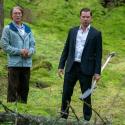
The opening scene alludes to the horrors of war and sectarian violence: a boatman (Ali Kareem) dredges from the murky water a young girl’s body daubed with the slogan, “This is the fate of fallen women.” Otherwise the bloodshed is glimpsed obliquely. (Pictured below: Karam Thamer as junior policeman Amad, armed for duty)
 Pachachi’s tapestry of intersecting stories, which has many of the strengths and weaknesses of Robert Altman’s Short Cuts, underlines how warfare kills the normalcy of day-to-day life.
“I don’t recognise Baghdad any more,” says a Sunni woman looking out a car window on her way to a funeral. Later on, her daughter rages at being harassed in the street for not wearing a hijab: “We’ve become savages. Us, the Americans, the whole world.”
Yet Pachachi’s movie, full of humanity, is also full of gallows humour. An elderly man caught in a machine-gun crossfire raises laughter from the other passengers with his mock outburst: “Don’t worry. We have the whole day in front of us. With lots of opportunities – explosive device, suicide belt, car bombs, mortars falling on your house!”
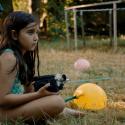
One of those passengers is the film’s central character Sara (Darina Al Joundi), a novelist who now uses her literary talent to write letters to the American authorities on behalf of friends searching for loved ones. Al Joundi’s nuanced, moving performance brings an emotional weight to her life as the child of a Shia-Sunni marriage who now lives with her own eight-year-old daughter Reema (Zainab Joda) and her brother Yahya (Amed Hashimi).
However, as the Altmanesque mosaic expands, with the addition of Mona (Labwa Arab), her mother (Siham Mustafa), her husband Kamal (Basim Hajar), her brother Kareem (Zaydun Khalaf), the hijab-refusenik Dijla (Myriam Abbas), who lives with her brother Nabil (Sami Al-Ali), who's confined to a wheelchair, next door to a Christian family that includes Sabiha (Badia Obaid) and another young daughter, Nour, and on and on, the broad brushstrokes and sentimental story arcs often result in a loss of focus. “My life’s become like a Mexican soap opera, long and stupid,” says Dilja at one point – a hazard that the film itself only narrowly avoids.
Nevertheless Pachachi captures the atmosphere of Baghdad, and her large cast of actors excels in the naturalistic mode of a film beautifully shot in widescreen by Jonathan Bloom, managing to depict the sensationalised visual landscape of destruction without stripping the city’s inhabitants of their individuality.
“This country is like a person you love who’s sick,” Sara says towards the end. “You can’t just abandon it.” Unlike so many international media reports, Pachachi’s film doesn’t abandon the people of Baghdad to the dehumanising fate of becoming news items.