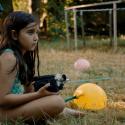
“We will sacrifice our souls for you!” yells out a class of kids in The President’s Cake, nominally addressing a leader hundreds of miles away – the Iraqi despot, Saddam Hussein. The slogan the children are forced to spew by their paranoid teachers is, on one level, mindless enough. On another, it goes to the heart of this exceedingly good movie: How much do you have to sell your soul in a dictatorship falling apart at the seams?
Set in 1990, not long before the first Gulf War, the film follows frantic days in the life of nine-year-old Lamia, who lives in a one-room wicker house on a wicker platform in the salt marshes of south-east Iraq. This picturesque waterworld is an ancient haven for the poor, equivalent to the forgotten Italian cave-scape in Christ Stopped at Eboli (1979). “Fresh water – a gift from the President!” announces the driver of a bowser that pulls up. The opening widescreen shots of the marsh at dusk, with bomber planes above and fire engulfing a wicker building in the distance, tell us we’re in able directorial hands – those of debut feature-maker Hasan Hadi.
Insistent guitar-like oud music mirrors the insistent Lamia, played with impressive control and range by Baneen Ahmed Nayyef – an “untrained” actor like most of the key cast. She lives with her indomitable gran, Bibi, a graven, growling, equally remarkable performer (Waheeda Thabet). Lamia hauls herself to school in a gondola-shaped rowboat, and after a teacher has filched her lunch – an apple – she’s picked out to make a cake for Saddam’s birthday in two days’ time.
She might as well be asked to make an electric car: flour, eggs and sugar are rare as hen’s teeth, plus unaffordable, under a sanctions-hit regime in economic freefall. But harsh family recriminations will follow from the soldiers who stalk the school if she whiffs on the task, expected in every classroom of the nation.
The bulk of the film takes place in a city nearby where Bibi takes Lamia for a new school uniform – for which she barters a valuable item, a radio, and then sets about offloading something even more precious. This is Lamia herself, for whom the bone-weary Bibi can no longer care. But the girl skedaddles into the crumbling concrete souks and streets of this scam-or-be-scammed metropolis – the mix of the modern and medieval that was Saddam’s Iraq.
Hooking up with a scallywag boy from school (Sajad Mohamad Qasem), she addresses the impossible task of getting the humble items for the cake. With no money, faced with tradesmen hanging by a money thread themselves, she’s in a desperate, developing world version of The Apprentice. Along for the ride, or the squawk, is a third striver – Lamia’s inquisitive pet rooster, toted around in a bag on her shoulder.
In Jean-Luc Godard’s Pierrot le Fou (1965), movie legend Sam Fuller declares: “A film is like a battleground. There’s love. Hate. Action. Violence. Death. In one word, emotions.” You could bulk that up here with despair, guilt, loss, anger, simple joy, sexual predation, survival and chickens. The President’s Cake is layered with ironies and the kind of absurdism that often seems to go with tyrannies. You might call the welter of vivid supporting characters Kipling-esque (or even, in a cake context, Mr Kipling-esque). They include a riddling mailman, a cheery blinded bridegroom, a jobsworth cop, and a Francophile shopkeeper with an eye on abuse. The kindness of strangers occasionally springs up amid the hawking bustle of the city.
Hasan Hadi’s pacey script was developed with the help of Eric Roth (veteran screenwriter of Forrest Gump), and every scene seems to release some new value right up to the final frames. That’s a Hollywood principle more often honoured in the breach these days, and might be taken more seriously in movies from beyond the West, like this Iraq-shot and Iraq-supported effort. (The director remembers the compulsory cake-making business from his own school days.)
The film seeks morality in a teetering society, and if it offers a moral imperative it’s that no one should be the first in line to judge, or be judged. Lamia has an uncertain life that she’s determined to live – to take on the adult world at its most implacable, to subvert it but never sacrifice her soul.