When least expected, comedy has come stumbling into the work of French auteur Bruno Dumont. In his seven films to date, from the Cannes-winning Humanité of 1999 through to the stark Camille Claudel 1915 from two years ago, the director, frequently working with non-professional actors, has marked out a distinctive territory defined by its bleakness and emotional intensity.
Which makes his latest, P’tit Quinquin, a departure indeed, both in mood and format. Though thematically the comedy is distinctly dark, its sense of the absurd is often laugh-out-loud funny, resulting in an ambiguous feeling that’s heightened by some of the physical characteristics of his cast. It’s a new direction in formal terms, too: made for television in four series (and originally broadcast in France in that form on ARTE), Quinquin nonetheless plays very naturally, at just under 200 minutes, as a consecutive story on the big screen (it debuted at the Cannes Film Festival last year).
Van der Weyden must surely acknowledge a debt to that other hapless French detective, 'Pink Panther'’s Inspector Clouseau
The links to Humanité are pronounced, on the surface at least, both in the crime mystery elements and police investigation narrative, and the setting in Dumont’s native Pas-de-Calais region of northern France. Quinquin takes place in the summer, which gives the flat, hardly conventional beauty of the landscape, with its quiet country roads and empty beaches, something of a halcyon feel (Guillaume Deffontaines’ loving widescreen cinematography certainly endorses such positive impressions). Nevertheless, we sense that this underpopulated farming area with its small town and scattered homesteads would be bleak in winter: some of the faces of its residents look like they’ve been buffeted by storms into almost gargoyle-like effigies.
 The face of the film’s eponymous hero (main picture), a completely winning role from Alane Delhaye, also seems somehow bruised by life: he could be a young prize-fighter, his hugely flexible physiognomy conveying the kid’s mood in details like the way the corners of his mouth turn up, and the quizzical frown that’s his most characteristic, and winning, expression. Quinquin’s just starting his holidays, which means the company of his girlfriend Eve (Lucy Caron, pictured above right with Delhaye) – they have a touchingly loyal affection which seems maturer than we might expect for their young years – and bicycling around with his gang of friends, investigating whatever’s going on.
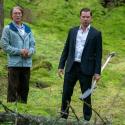
A fair amount of the first episode sets this leisurely scene, seen beguilingly through the children’s eyes, and Dumont doesn’t hurry to introduce the wider action. When he does, however, it’s in a way bound to attract the kids’ attention, with a dead cow being hoisted by helicopter out of the depths of a derelict World War Two bunker. The police are already on the scene, led by the inimitable double-act that is the film’s comic tour-de-force, Bernard Provost playing the voluble investigator Captain van der Weyden, Philippe Jore his taciturn sidekick lieutenant Carpentier (pictured below, Provost at right). Van der Weyden must surely acknowledge a debt to that other hapless French detective, Pink Panther’s Inspector Clouseau, and his involuntary facial contortions – he’s a ’tec with a tic – are frequently scene-stealers. His various portentous utterances (he has a distinctly Zola-esque tendency to see the hand of the Devil everywhere, a longterm preoccupation of Dumont, too) are no less laconic.
 There’s nothing comic in the crimes they’re investigating, however: the first two murders involve human body parts stuffed into dead cows’ innards, and later ones are hardly more photogenic. It becomes clear that there’s something very dark in this rural community, though its exact location remains tantalisingly concealed; this gang of children has no Famous Five-style innocence either, and Quinquin reveals himself on occasions a pugnacious little tyke who’s no stranger to racism (nor indeed are the policemen). That becomes clearest in the fourth series, in which the simmering conflicts between the town’s indigenous French inhabitants and those who have arrived there from further afield culminate in a shocking incident of the kind that we’ve seen rather many of recently in France.
Dumont plays ironically with the expectations of the detective genre, subverting them nicely (and earning the director comparisons with David Lynch and Twin Peaks), while the series format also gives him extra length to let scenes run longer, not for any narrative purpose but instead for frequently surreal development of theme and character. There’s a prolonged early funeral service that’s rich in unalleviated eccentricity, its humour qualified by our wondering whether Dumont is exploiting the real-life mental peculiarities of his cast (finally, I think, he doesn’t), while the scene of the town’s Bastille Day celebrations has viewers simultaneously laughing at proceedings and strangely touched by their underlying humanity. Dumont has a palpable relish for everything (and everyone) to which his script introduces us which is infectious, while leaving it up to viewers to qualify its underlying complexities.
Overleaf: watch the trailer for P'tit Quinquin