Making sense of The Strange Colour of Your Body’s Tears is impossible. Beyond some early scene-setting, this Giallo-inspired film has no narrative and, apart from its protagonist, it becomes increasingly difficult to work out who is who, what is what and whether anything relates to anything else. Depicting reality is not on the minds of Belgian director and screenwriter, Hélène Cattet and Bruno Forzani. An impressionistic take on Italian genre cinema of the Seventies, it confounds, then delights and ultimately electrifies.
The Strange Colour of Your Body’s Tears (L'étrange couleur des larmes de ton corps) begins as Dan Kristensen returns home to Brussels after a business trip. Telephone messages he has left for his wife while away haven’t met with a response. On arriving at their apartment, he finds it locked from the inside. Forcing his way in, he finds no one is there. In a frenzy, he rings the doorbells of neighbours, calls the police and tries to find out what has happened to his wife. A woman living in an upstairs apartment says her husband also vanished mysteriously. He encounters a naked woman called Barbara who is smoking on the roof of the block.
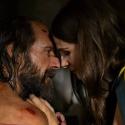
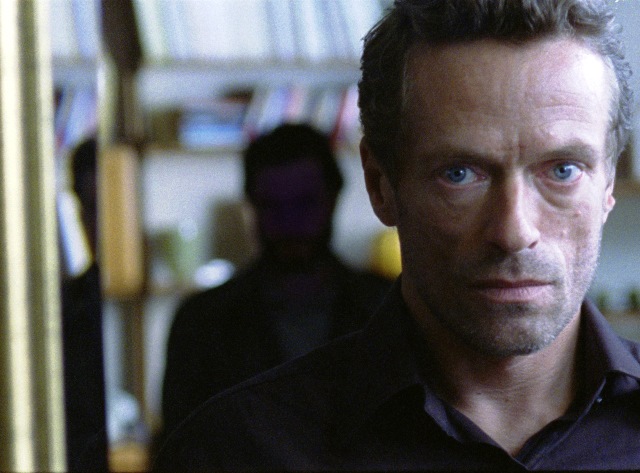 The next morning, a police inspector called Vincentelli turns up in response to the call. He tells Kristensen about another missing woman. Investigating that case left him with scars. Kristensen discovers the building has secret corridors linking each apartment. All the while, he seems to spill in and out of reality. (pictured right: Klaus Tange as Dan Kristensen)
That much appears to be clear. But Kristensen, played by Danish actor Klaus Tange (also seen in Borgen and The Killing), encounters a string of people who may or may not be real and series of situations which might or might not be in his imagination: a bearded man could be a suspect in his wife’s vanishing; a woman dressed head-to-toe in red is possibly involved; a severed head which may be that of his wife appears in his bed. Does he even have a wife?
Strange Colour is Cattet and Forzani’s second full-length film and follows their equally distinctive but less opaque Amer. Cinemas welcomed Peter Strickland’s similarly inclined Berberian Sound Studio and, despite the greater level of impenetrability, there is no reason why Strange Colour can’t be embraced by anyone intrigued by the comparably neo-Giallo milieu. Indeed, Strickland crops up in the credits for recording a scream.
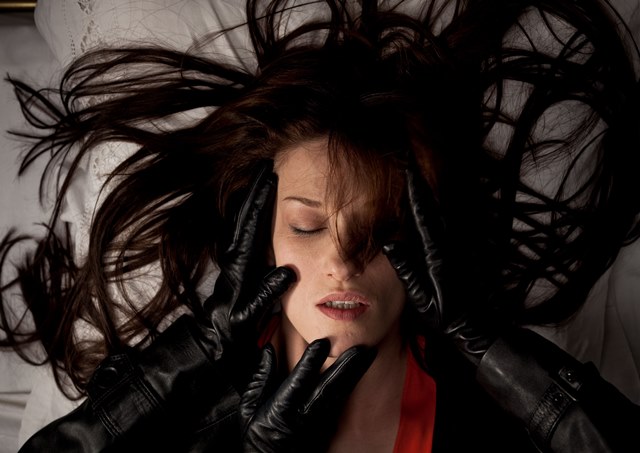 Antecedents from the 1970s include Dario Argento, especially The Bird With the Crystal Plumage. The opening scenes in the apartment block also echo those of Susperia, while the black gloves and knives are directly drawn from his work too (pictured left, Ursula Bedena). There are nods to Don’t Look Now and Blue Sunshine (1978), while Cattet and Forzani use vintage Italian music by Alessandro Alessandroni, Ennio Morricone, Bruno Nicolai and Riz Ortolani.
Yet no Seventies film was this far out. There are Mike Figgis-style split screens, slow-mo shattering glass, eerie Mario Bava-derived colour wash, people seen through bevelled glass, kaleidoscopic images, scenes repeated to emphasise the film’s dream-like state, breath-taking art nouveau interiors, references to their own films (a masturbation sequence reuses the O for Orgasm segment from ABC’s of Death), eyes which change colour to match the stones set into jewellery, an incredible sound design foregrounding noises such the ting of a knife’s metal blade, and characters who disorientingly meet themselves. It goes on.
The Strange Colour of Your Body’s Tears is dizzying stuff - film about film: a meta film like no other. A wild ride, it’s guaranteed to blow minds. Hop on.
Overleaf: watch the trailer for The Strange Colour of Your Body’s Tears
Watch the trailer for The Strange Colour of Your Body’s Tears