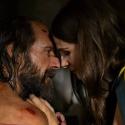
Gary Oldman has always lived life to the fullest, on screen and off. Maybe that's why he is often at his best in his pitch-perfect portraits of real-life personae such as Winston Churchill in Darkest Hour and Herman J Mankiewicz in Mank. He now stars as the bibulous middle-aged American author John Cheever in Parthenope, Paolo Sorrentino's latest lush homage to Italy's recent past.
Oldman's Cheever is little more than a cameo, but his performance is genuinely touching – poignant and witty, appreciative of the beautiful young protagonist (Celeste Dalla Porta) but detached from her. Talking about the film last year in Cannes, Oldman looked back at his life and work and discussed his old demons and future plans.
PAMELA JAHN: You've always had a clear sense of how to embody real-life personalities, from Sid Vicious to Winston Churchill and now John Cheever. What is your secret?
GARY OLDMAN: Fear. I always had an extremely uncomfortable feeling about it. Even George Smiley was real to me in a way, because he had become an icon through John le Carré's novel Tinker, Tailor, Soldier, Spy and Alec Guinness's portrayal in the acclaimed 1979 BBC series. John Cheever is more of an exception. I don't play him as in a biopic, but as a larger-than-life, melancholic, romantic figure sprung from Paolo Sorrentino's imagination.
Were you familiar with Cheever's writing?
I read "The Swimmer" years ago and knew a little about his life from interviews. But that wasn't really the point here. The encounter between Parthenope and Cheever is just one piece of the sparkling mosaic that this film creates.
 You made your directorial debut in 1997 with Nil by Mouth. Why did you leave it at that?
After that, I worked for a long time on adapting a book by Darin Strauss called Chang and Eng, a wonderful epic about Siamese twins, but it never came to fruition. I couldn't finance it. And my current project, Flying Horse, about the photographer Eadweard Muybridge and the early days of cinema, is also on hold because we don't have the necessary funds. Thirty million dollars – I don't have that kind of money.
So, you'd rather give it up than compromise?
I'm lucky enough to be able to earn a living as an actor. I don't have to direct films at all costs. I've seen too often what happens when the budget suddenly gets tight. They tear pages out of the script and change the story – rarely for the better. I don't want to work like that.
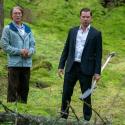
You're currently enjoying huge success as Jackson Lamb (pictured above) in the spy thriller series Slow Horses, based on Mick Herron's novels. What is it about the character that appeals to you?
He's my pension. At my age, it's anything but a given that I'll be offered such a great project again. The fifth season has already been filmed, and the sixth is in the planning stages.
Doesn't it bother you that you might have to turn down exciting film projects because of your commitment to the show?
I'm happier than I've ever been in my life. The most important thing is that I've been sober for over 27 years. Otherwise, I wouldn't be sitting here today. I'd be dead. Since I stopped drinking, a lot of things have happened that I will always be eternally grateful for. I'm not so lonely any more, I'm not lying around in some hotel room, wrecked, living out of a suitcase. There were years when I was pretty gloomy and very self-destructive.
What made you want to change?
In the mid-1990s, I starred alongside Demi Moore in the film The Scarlet Letter. One day, I arrived on set drunk. It was an important scene. I somehow got through it, but don't ask me how. I was completely out of it. When I was sober again, I apologised to Demi. I thought she must hate me. I was ashamed that I had been so unprofessional. But she just said, "It's OK. I don't hate you. I'm just disappointed." That was it. At that moment, I knew I couldn't go on like that.
Was playing James Gordon in Christopher Nolan's Batman Begins another turning point in your career?
In a way, yes, because I decided not to play villains after that. It was fun for a while, until Harrison Ford started calling me Scary Gary. That was his nickname for me.
Have you ever fought for a role?
Only once: Mason Verger in Ridley Scott's Hannibal. I had heard that they wanted to re-create the character with an animatronic puppet, and I thought to myself, 'What a stupid idea!' I called Ridley and suggested that I take the part. I had read the book and thought Verger was great – such a wild character.
 What has been the bravest decision of your career so far?
Playing Winston Churchill [in Darkest Hour, pictured left]. I turned it down half a dozen times. My wife finally convinced me. She said, "Do it – it might be great, and if not, then to hell with it. But you want to say those famous words: 'We shall fight on the beaches.'" And with that, she had me!
Has your opinion of Churchill changed since then?
I've always admired him greatly, and the film only reinforced that. The man wrote more than Shakespeare and Charles Dickens together. Speeches, memos, all those letters. And not only that, he painted, ruled a country, and took on the Nazis. A man who smoked so many cigars and drank so much alcohol.
Is there anything you learned from him?
I got the best piece of advice ever from Anthony Hopkins before filming Darkest Hour. He asked me, "Do you know what the shortest prayer in the world is?" I said, "No," and he replied, "Fuck it."