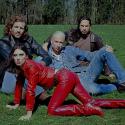
Here’s a deceptively simple question. What is African music? Does a band make African music simply by dint of the fact they come from Africa? One of last night’s three African Soul Rebels acts was South Africa’s Kalahari Surfers. Ensconced behind a table’s worth of laptops and other gismos, they made subtly menacing, dubby rock with an early '80s slant. And in fact they did it rather well, conjuring memories of Gang of Four and their ilk.
Warrick Sony, the band’s vocalist looked and sounded a little like Billy Bragg, and his fractured, edgy guitar work was involving. There was even one moment in their set when things picked up in tempo and mood with a reggae number, but was this African music? Myself, and a smattering of people who headed for the bar during their first number, seemed to think not.
The incongruity of Kalahari Surfers seemed to be magnified by the fact that their icy electronica-tinged rock set was stuck right in the middle of the evening, like an interlude that wasn’t meant to be an interlude, separating two of the most exciting African bands operating today. These two bands could be used to give us a working definition of when African music really is African music: It should have polyrhythms a plenty; at least one vegetable-based percussion instrument; some call and response vocals (requiring audience participation, obviously), and no more than one song in a minor key.
Benin’s fiercely funky Orchestre Poly-Rythmo de Cotonou wasted no time in satisfying all these requirements. This formidable 10-piece produce a satisfying blend of complex Vodun (a polytheistic religion) rhythms, American blaxploitation-era funk, and Latin brass. The only problem was that they barely seemed to have gotten up a decent head of steam when – due to unavoidable time restrictions – they had to bring things to a close. Their penultimate song, the slinky Afrobeat number, “Ou C’est Lui Ou C’est Moi – Re,” found their leader, Melome Clement, introducing the band, at a point at which the audience could have easily handled at least another hour of their compelling, driving grooves. So let’s hope that next time, they come back as headliners and therefore have more time in which to spread their wings.
One could draw parallels between the Poly-Rythmos and Senegal’s Orchestra Baobab, who also had great success in the 1970s at home, but have only really gained international acclaim in the past decade. I see no reason (on the evidence of several recent compilations as well as last night’s performance) why they shouldn’t follow suit. Apparently they have a back catalogue of some five hundred songs, so they’re not short of material. The evening’s other quintessentially African act - and the one most of the audience had really come to see - was the… perhaps even “diva” is now too small, and too devalued a word to describe the big haired, resplendent in pink, regal form that strode onto the stage and filled the auditorium with her voice.
When Oumou says, “Everybody, get up and dance!” - everybody – and I do mean everybody – instantly gets up on their feet. Although she has a tough and sinuous band who never put a foot wrong, it’s Oumou’s voice, as it moves from subtle and breath textured to smoothly soaring, that holds your focus. It effortlessly rises above the intricate twang and clatter of ngoni, guitar, and percussion, unhampered by the flutist that occasionally shadows her melodies with his own. And then there are those two backing vocalists who delighted in turning into human whirlwinds, and seemed to drive the musicians to greater levels of intensity, as much as the musicians drove them to dance. Now, that’s African music!
A lengthy version of “Yala” (but no version of “Yala” could be too long, in my opinion) closes the show, before all three bands return to the stage for a somewhat chaotic but nevertheless enjoyable run through “Wele Wele Wintou” from Oumou’s latest album Seya.