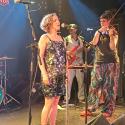
Many press releases from now up until Christmas are sure to begin with the words, “Fresh from wowing the crowds at Glastonbury…”, but that’s not going to stop me using them now with reference to this great Malian band. This is because we world music journalists feel a particular swell of pride when one of our beloved acts breaks through the Womad glass ceiling and gets to bring their complex polyrhythms and weird-looking instruments to the mainstream music fan. And what’s more, in the case of Ngoni ba, I’m sure that they genuinely did “wow” that sea of sun-burnt punters, because having seen them at least half a dozen times I’ve yet to witness an audience that hasn’t been pulled into their vortex of duelling ngonis, thumped and slapped calabash, and sweet soaring vocals.
Their 2007 debut release Segu Blue was an exquisite affair that, despite becoming many critic’s African album of the year, barely hinted at the storm the band cook up live. So when I Speak Fula was released last year, and came closer to capturing the dynamism and sheer physical presence of their live performances, it was greeted with even more enthusiasm. So now Bassekou has an audience who have high expectations, and last night’s Barbican crowd weren’t let down. The first few numbers were taken at a leisurely pace with restrained bursts of angular soloing from both Bassekou and his three fellow ngoni players (the ngoni, by the way, is a cricket bat-shaped distant relative of the banjo) but then as soon as this Malian genius placed one foot up on the stage monitor, we all knew he was about to step things up a gear.
The best way to sum up Bassekou’s appeal is by saying that there’s not a single guitarist alive today who I would want to hear play two- or three-minute solos, one after the other, in almost every song they performed. I couldn’t imagine anything worse. And the comparison isn’t fatuous. The electrified ngoni, particularly when it’s also played through a wah-wah pedal, can sound very guitar-like, and this master of the instrument has as much time for Jimi Hendrix as he has for the griot tradition of playing that goes back centuries. But because of the ngoni’s small body, the notes produced have plenty of attack but very little sustain, so the histrionics of the lead guitarist is easily circumvented.
Not that I want to detract from what Bassekou has achieved with the instrument. It was a mere bit-part player in African music until he moved it centre stage, and there’s little doubt that it will remain centre stage for a long time to come, thanks to his playing. Each time that foot goes up on the stage monitor, another rush and tumble of jagged notes pour out. Sometimes he’ll just bend a string and hit the same note a dozen times, drawing whoops of approval from the audience. While in the meantime, at the still centre of this ngoni storm is Bassekou’s wife, Amy Sacko. Most of the time her voice has a soft timbre to it which makes her very different from many other Malian divas, but then during some of the more up-tempo numbers she’ll jump an octave and cleave the air apart with her other, more strident voice. It’s a usual weapon to have at her disposal, for when Ngoni ba are going full tilt they create a dense mesh of sound which a lesser vocalist would never penetrate.
Midway through the set the great ngoni master said a few quiet words in French about his, “friend and brother” Charlie Gillett, who died earlier this year. There followed an extraordinarily moving desert blues track in which the boom of bass ngoni sounded like a giant's pulse, and Amy rang every last drop of loss and pain out of the minor-key melody. It was a perfect tribute to the great man and broadcaster who did so much to bring Ngoni ba – and hundreds of other musicians over four decades - to a wider audience. After that it was on to the home stretch for half an hour of full-on African blues and funk including a fiercely powerful version of “Jonkoloni” which bore little relation to its polite, restrained studio recording.
I should briefly mention support act Ballake Sissoko & Vincent Segal, a duo who play kora and cello respectively. They produced gentle music which seemed almost reluctant to impose itself on the respectful silence given to it by a rapt audience. A little too polite for my tastes, but I’ve no doubt they will find an appreciative audience for their aptly titled Chamber Music which is released later this month.
Watch the band live on Later With Jool’s Holland in 2007