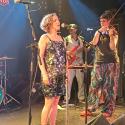
The Human League front-load their set to such a degree it’s unclear how they’re going to maintain such momentum. Their stage set is amazing, just for starters. Stage-length steps rise up to a podium at the back, on which two synth-players are placed either side of the drummer, the backing band, all of them and all around in white. Surrounding the whole lot are three layers of equally white hoarding upon which projections and lighting effects envelop the performance. It’s extremely well designed, impressive and effective.
Susan Sully and Joanne Catherall appear to cheers, clad in white dresses that style them as Delphic oracles. They are two thirds of the current League, famously plucked as school girls from a Sheffield night club in 1980 by lead singer Phil Oakey, immediately going on tour as singer-dancers then becoming full members. Oakey appears last looking very sharp, all in black by contrast with his surroundings, slim, shaven-headed, wearing a fitted knee-lenth black jacket and a pair of round-framed shades. He looks a little like Laurence Fishburne in The Matrix.
Oakey’s low singing voice is well matched by the sweetness of Sully and Catherall’s tones
The opening song is the bubbly “Mirror Man” and, from there, they crack on through “Sound of the Crowd” and “The Things That Dreams Are Made Of”, 24-carat Eighties electro-pop gems all. They then veer off into newer material, such as the pounding “Egomaniac” from their last album, 2011’s Credo, but the highlight of the show, arguably, comes during the set’s mid-section which includes the songs “Seconds” and “The Lebanon”. The former is an elongated slowie and another number from 1981’s fabulous Dare album, bewailing the assassination of President Kennedy, presented amidst a hail of red numbers against a black backdrop, while the latter, from 1984’s Hysteria album is surprisingly rocky, swathes of U2-like guitar boosting its air of protest. The League have often been mocked for their lyrics and it’s true that Oakey has a penchant for the preposterous couplet (“And where there used to be some shops/Is where the snipers sometimes hide”), but played straight these two songs have an unexpected potency.
Oakey’s low singing voice is well matched by the sweetness of Sully and Catherall’s tones. It’s a vocal style that he will be able to muster until he is old, a reminder of the way punk ushered in freedom to express oneself in a multiplicity of singing styles, long before X-Factor-propelled notions of “technique” homogenized pop. Indeed, the Human League were one of the synth groups who invaded the charts after punk, bands that were more punk than punk in that they escaped tired rock’n’roll completely and instead used Kraftwerk as their template. Yet their music was also so very pop, which is why the Brighton Centre lights up with joy when “Don’t You Want Me” arrives. It was at the top of the charts over Christmas 33 years ago and, this being the festive season, groups of friends are up for a burst of jolly booze-fuelled nostalgia, so the song is a communal spirit-raiser and sing-along.
The encore, with Sully and Catherall now in somewhat burlesque-flavoured attire, consisted of two numbers from the album Phil Oakey did with disco and soundtrack kingpin Giorgio Moroder back in 1985. Now that Moroder is very much flavour of the month again, following Daft Punk’s endorsement, Oakey is, perhaps, pointing out that he was there decades ago. Then again, as he has also observed, the Human League’s version of pop – the electronic sort – is what all pop has become. Thus, as they close with “Together in Electric Dreams”, this group which started out in the late 1970s appears to not only be a massive amount of fun, but also very prescient.
Overleaf: Watch the video for "Mirror Man"