“The case is quite simple. We think that the policy which is being pursued by the western powers is one which is almost bound to end in the extermination of the human race. Some of us think that might be rather a pity.”
This extract from a 1958 interview with Bertrand Russell opens Ban The Bomb - Music Of The Aldermaston Anti-Nuclear Marches, a two-CD set collecting music and interview snippets associated with the early days of CND and the related anti-nuclear protest. Next up in the tracklist is Ewan MacColl & Peggy Seeger’s “March With us Today” which exhorts listeners to come to Trafalgar Square and then join in with the ensuing march to Aldermaston in Berkshire, the home of an RAF base and the UK’s Atomic Weapons Research Establishment.
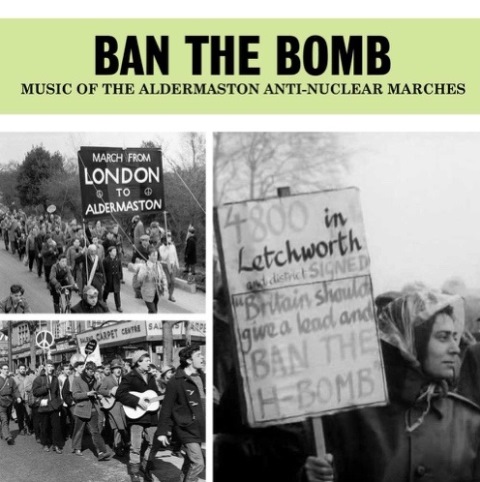 MacColl’s lyrics for “March With us Today” – first issued on a 1962 album – declare “Ban the Bomb, end the war! That's what this march is for, To Trafalgar Square in London we will go.” The first March took place over Easter 1958. It became an annual event. The final march took place in 1963, after which things continued in a piecemeal fashion.
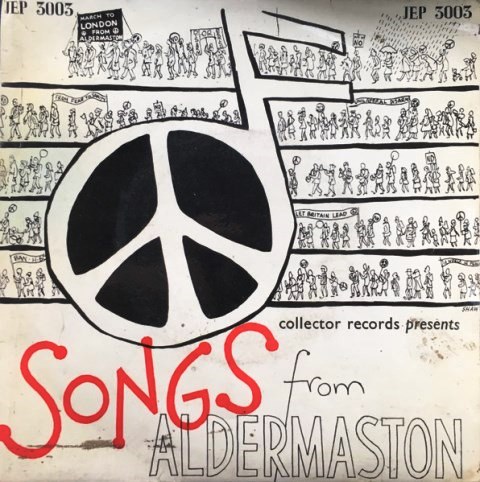
“March With us Today” is a folk-styled song, composed in reaction to the protests and the issues which generated them. In Ban The Bomb’s reading, the soundtrack generated by the marches was a mixture of folk music and the then-popular trad jazz. What’s collected includes Ken Colyer’s Jazzmen (who also played the first march), Chris Barber’s Jazz Band, George Melly with Mick Mulligan’s Band, Acker Bilk and his Paramount Jazz Band and other jazzers alongside folknik types like Ewan MacColl & Betty Seeger, and Fred & Betty Dallas. Trad was already a thing, so it was co-opted by the protest movement.
Yet even though the City Ramblers Skiffle Group played during the first march, skiffle – the music then turning the heads of the nation’s youth – is absent from Ban The Bomb; rock ‘n’ roll was beginning its UK rise in 1958, so couldn’t yet have reared its head.
 Giving this context, a quote from The Daily Mail included in Ban The Bomb’s booklet says that at the first protest “the marchers were mainly middle-class and professional people. They were the sort of people who would normally spend Easter listening to a Beethoven concert on the Home Service, pouring dry sherry from a decanter for the neighbours, painting Picasso designs on hard-boiled eggs, attempting the literary competition in the weekly papers, or going to church with the children. Instead they were walking through the streets in their old clothes. They were behaving entirely against the normal tradition of their class, their neighbourhood, and their upbringing.”
That may have been the case, but instead of Beethoven, etc., associations with the relatively grown-up and sophisticated – in comparison to skiffle – folk and jazz renders it hard to disagree with The Daily Mail’s assessment that the marchers were “mainly middle-class and professional people.”
In essence, then, the extremely interesting Ban The Bomb documents what seems to be a middle-class or higher-education accompaniment to the protests: a skiffle-free zone. And as rock ’n’ roll increasingly cast its spell over the UK’s youth, the music tied to the anti-nuclear protests became removed from what was heading into the charts. In time, skiffle helped generate the British rock ’n’ roll boom and the ensuing beat boom, but beyond its limited presence in the early days of the Aldermaston marches it appears not to have become integral to the protests. After trad jazz lost its lustre, it’d take a few more years – and the arrival of Bob Dylan – for music associated with protest to get into the charts.
- Next week: Whatever You Want - Bob Crewe's 60s Soul Sounds
- More reissue reviews on theartsdesk
- Kieron Tyler’s website