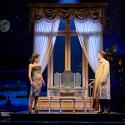
At its heart is a knotty and quite compelling moral dilemma. Stationmaster Thomas Hudetz, in a small, unnamed Austrian town, unhappily married to a much older woman, allows himself to be distracted by the daughter, Anna, of the local innkeeper. It really boils down to a not overwhelming kiss when he should be attending to the signals; but as a result of Anna's impulsiveness - it's a big kiss but no more than that - trains collide and two dozen are killed.
Hudetz is investigated by the local public prosecutor and Anna saves the stationmaster's skin by insisting that she was the only one with Hudetz when the accident happened and that he's done nothing out of order. In perjuring herself, and encouraging Hudetz to believe that they might have life together, von Horváth mixes ingredients for a perfectly watchable modern tragedy; but the impression left, after whatever is done with this material, is that the temperature can't actually be raised to much beyond social melodrama.
True, he was writing at the height of Nazism and was by all accounts fascinated rather than, strictly speaking, horrified by it; unlike Brecht, von Horváth stuck around in 1930s Germany and, in order to work, was forced to join the Nazis' writers union - and then met a rather banal demise in Paris in 1938 when a storm dislodged a branch from a tree which fell on and killed him.
Clearly, Judgment Day examines the nature of conscience and the ability or otherwise of a wrongdoer to accept the consequences of his or her actions. The play's townsfolk require a culprit and suspicion of Hudetz inevitably intensifies. His brother-in-law protests his integrity and is ostracised for doing so; Hudetz begins, noticeably - and this provides the play's main psychological drama - to feel the pressure. Anna, in ambiguous circumstances - does Hudetz do away with her? - becomes the virginal victim.
All of this has great potential but my feeling is that von Horváth's text needs taking liberties with. Hampton's curiously stilted idiom - "Gosh," says Anna at one point; "I'm not going to get a divorce, do you understand?" says Hudetz's wife, huffily; "I'll eat my hat," says one of Hudetz's detractors - places it not unadjacent to Celia Johnson and Trevor Howard in Brief Encounter. But a customer at the inn then making liberal use of the "f" word renders the tone dreadfully inconsistent.
Joseph Millson is a charismatic Hudetz and David Annen particularly strong as Alfons, his conflicted brother-in-law. Proceedings are especially heightened by Laura Donnelly's Anna, by turns skittish, imploring and hot-blooded: we're left in no doubt as to how Hudetz could have his head so fatally turned.
But the production, directed by James Macdonald, is generally too safe. Costumes are drearily period - all country-comfy and plus-fours - and, in one crucial scene, when Anna, in white, approaches from mist on a viaduct to seduce Hudetz again, no time at all is given to ratcheting up the erotic danger between them. We want to sense their desire and tension; without them, the catastrophe and love at the play's heart remain just a bit pedestrian. Which indeed is the problem throughout this agreeable but, even with bells, whistles and charging train sounds, unstunning hour-and-three-quarters. Judgment Day is goodish play but so much more could be made of it.