Well, we all make mistakes. Or, in my case, we (I mean “I”) sometimes just fail to look. This new, small but perfectly formed exhibition of Bridget Riley’s work in the National Gallery’s Sunley Rooms follows the pattern that the gallery has developed over the years, with a single artist entering into a conversation with the great art of the past. Riley’s conversation is gripping, and one of the things it says (to me) is, “Shame on you for not looking.”
 Shame on me indeed, for I have for far too long looked but not seen, tagging Riley as an Op Art operator, shrugging her off as “very good, but not my thing”. Well, she should be everybody’s thing, and I am suitably chastened. In the first of the show's two rooms, an early piece from 1965, Arrest 3 (pictured right) is concerned with the things of the 1960s – with showing the surface of the work, with abstraction – but it is far more nuanced than that description makes it sound, and on the wall opposite, one sees why, for there hangs Mantegna’s The Introduction of the Cult of Cybele at Rome, where Mantegna, nearly 500 years earlier, in this masterpiece of grisaille, focuses on the same concerns that Riley has picked up and begun to explore: picture surface, pictorial space, and the tension between paint and what is painted.
Then follow three small Seurat sketches, and seeing them here, it becomes so clear that it is Seurat who has been the guiding light of Riley’s processes, exploring the colour-world, examining how we view it, how it in turn is changed by what is put side by side. And, most importantly, how Seurat used colour to create composition, rather than creating compositions, and then adding colour to them. This has been the heartbeat of Riley's work, and it is wonderfully displayed in the next room, in a series of works from the last 10 years of her career.
Red with Red 1 (main picture above) uses the diagonals that Riley has made the basis of her pictures’ dynamism, layering red and hot pink side by side, finding out how the eye separates and merges colour, both letting the eye move forward, and then stopping it sharply, like a brake suddenly applied.
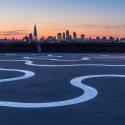
This is followed by an enlightening run of paintings, gouaches and a wall painting, all using a colour palette of greens and blues, a palette both dense and flat, and showing how only minor shifts, absences and presences, can alter the entire balance, the entire thrust of an image, how they can make it new again. Yet the most moving part of the show is how this is all done with such modesty, such quiet grace. This is not the flashy, gaudy, look-at-me art we have become so used to ever since Pop Art linked art, celebrity and money into a vicious cycle of co-dependency. Instead, here we have an artist who pays homage to her heritage, an artist who has, over more than half a century, worked seriously, devotedly, dedicating herself to looking, to seeing, and to encouraging us, through that work, to look and see too. The wall painting Arcadia 1 (pictured left) faces an extraordinary work, a wall drawing created for this show, Composition with Circles, also directly applied on to the gallery wall: here Riley returns to the curve, and with remarkable sparseness creates the same sense of dense, layered space that she produced in Arcadia and its fellows, but using only black and white, and drawing rather than painting. What makes it so wonderful is the way the richness has been achieved without colour, with only drawing: a richness achieved through a lifetime of examining colour and exploring its possibilities.
And just like Composition with Circles, Bridget Riley: Paintings and Related Work is a gem of a show: spare yet rich, dense yet austere. And its very spareness – only 11 of Riley's works are on show here – is its final triumph, focusing on quality over quantity, seeing over looking.
- Bridget Riley: Paintings and related Work at the National Gallery until 22 May, 2011
- See a display of Bridget Riley's student works at the National Portrait Gallery
- Find Bridget Riley by Colin Wiggins, on Amazon