As a world music critic one gets used to the stream of superlatives that generally arrive in the wake of whatever big new act is being plugged. World music promoters have a particularly hard job because they don’t just want to preach to the converted; they also want to try to get some new listeners to widen their musical horizons a little. So even before I’d heard a note of the Creole Choir of Cuba I knew that they’d gone down a storm at the Edinburgh Festival, that Jools Holland’s producer wanted them for Later..., and that they were booked to do various BBC radio sessions.
The predictable parade of spot-lit adjectives were deployed: “mesmerising”, “jubilant”, “vibrant” and, most irritatingly of all, “colourful” (irritating because it seems to be the current PC euphemism for exotic and/or foreign) fell upon my contrary ears and made me suspect this lot were going to be too coffee-table tasteful to engage me. But as it turned out, colourful they most certainly were, as well as mesmerising, jubilant and vibrant. So that showed me.
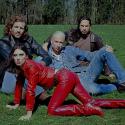
Yes, from the opening number onwards, these four men and six women demonstrated they were going to live up to the hype. Back in November of last year, Robin Denselow suggested in The Guardian that they still had a way to go before they achieved the professionalism and excellence of the vaguely comparable (because they're another big vocal group) Ladysmith Black Mambazo. Well, perhaps Denselow saw them on a bad night, or they’ve simply worked hard to iron out all their flaws, but last night at the Barbican they were fantastic. What with AfroCubism's recent stunning performance, Cuba really seems to be delivering the goods at the moment.
Controversially perhaps, I’ve always felt that if you’ve heard one beautifully sculpted a cappella tune from Ladysmith Black Mambazo you’ve heard all 30 of their albums. This group of descendents of Haitian plantation workers seemed subtly to reinvent their sonic signature with every song they performed. For example, in their second number, “Edem chante” from their new album Tande-la, the majority of the choir used their voices to simulate the booming thuds of a fast-beating heart, while the soloist sung the haunting main melody in creole (Cuba's second language) over this vocalised rhythm. Because each song featured a different soloist with a different timbre and character to their voice, it meant that a song about, for example, slavery or children orphaned by natural disasters, got the appropriate voice delivering it.
After an unnecessary interval (what was the sense in breaking such a hypnotic and immersive experience in two?) we were treated to the choir’s “gift” to us Londoners. This was an ethereal rendition of Nat King Cole’s classic ballad “Unforgettable” which, needless to say, is sure to remain in the memory. On several occasions throughout the evening I simply forgot I was listening to no more than just 10 human voices, two congas and some hand percussion: the inventiveness of the choir’s arrangements gave the impression that a full band was churning away behind them. And then when those 10 voices came together to create one blazing pitch-perfect chord it was as if two hands had come down hard on the keys of a sizeable church organ.
So what's their secret? Well, somehow this choir have melded the austere linearity of the classical tradition to the full-on emotionally cathartic power of gospel, before finally giving the whole thing some Cuban and Haitian sweat and swing (these guys can dance too). In other words, it seemed like all humanity was here in this music, happily battling it out just to say, "This is who we are, where we’ve come from, and where we are going." So although I go along with “jubilant” and “vibrant” I would also add sublime, breathtaking, and almost frightening in its flawed perfection. The other day I started the novel 36 Arguments for the Existence of God by Rebecca Goldstein. Although the title is part ironic, the agnostic in me – despite protests from the atheist - would like to propose The Creole Choir of Cuba as the 37th argument. A blinding, awe-inspiring and – dare I say it – transcendent evening.
- Find The Creole Choir of Cuba on Amazon
Watch The Creole Choir of Cuba performing “Tande”