

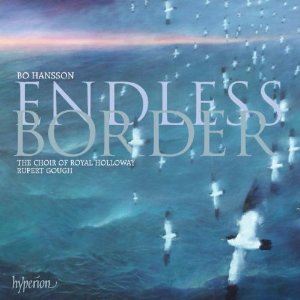
Swedish composer Bo Hansson began his musical life as a guitarist and teacher, moving into composition in his thirties. Hansson writes in the sleeve note that “the human voice is the nearest you can come to your soul.” And you’d be forgiven for expecting, with trepidation, an hour of wishy-washy new-age mediocrity. Fortunately the music on this disc is consistently good; Hansson’s beginnings as an arranger of folk and popular song have helped him develop gifts as a writer of contemporary choral music that really does exert a grip. Five of the pieces in this collection set religious texts. Salve Regina is a good starting point; the hypnotic overlapping chants grip from the outset. More ambitious is the 20-minute Missa Brevis. Hansson’s movements typically start softly, obliquely, the textures thickening and the rhythms developing in complexity until you suddenly find yourself somewhere luxuriant and concordant. The brief Agnus Dei is a good example. The musical processes are sophisticated but always easy to follow.
Som när handen (As when the day dawns) contains delicious chord changes. For as the rain begins with the choir intoning over an angular, minimalist organ riff, approachable dissonance contrasted with juicy major-key writing. Endless Border is a compact, seven-minute marvel. Hansson knows how to structure and pace his settings; nothing here is a bar longer than it needs to be. Rupert Gough’s young choir make a glowing sound, recorded in an acoustic which gives them plenty of air but never clouds the detail.

Mahler’s gargantuan Symphony no 3 is one of those works which rarely seems to last as long as you think it does; the timings on the CD booklet inspire trepidation, but the minutes usually fly by. Of all Mahler’s symphonies, this one seems to have attracted the fewest dud recordings. The emotional language is positive, clear and unambiguous, and there’s a lot of warmth and wit to offset the bombast. Sensible conductors will let the music speak for itself. Get the kaleidoscopic mood and tempo changes right and the symphony will feel reassuringly traditional. Accentuate the bizarre juxtapositions and it can sound intriguingly modern. Markus Stenz’s clear-sighted approach takes the former option and his performance is a delight. The vast opening movement, longer than most classical symphonies, starts with a magnificent horn blast, more impressive here for being so immaculately in tune. And younger conductors always seem more alive to the craziness of the central march section; Stenz’s brassy brashness suggests Sousa or Charles Ives.
The central movements are similarly entertaining. The tiny details are all there, but never overemphasised at the expense of the music’s flow. The minuet’s delicate close is rapt, and the third movement’s posthorn is rightly magical. Michaela Schuster’s solemn eloquence provides the requisite stillness at the symphony’s heart, and the jauntiness of the Cologne boys’ singing in the brief fifth movement is a joy. It’s a near-flawless performance, capped by a flowing, heartfelt Adagio. Much as I like live recordings, the fact that Stenz’s was taped in the studio offers one big advantage, namely that the orchestra don’t sound collectively knackered as they reach the final D major cadence. Plus, the SACD sound is wonderful – listen carefully and you’ll hear things you’ve not heard before. This is the best release so far in Stenz’s ongoing Mahler series.

Shostakovich’s Violin Concerto no 1 is practically standard repertoire now. The follow-up is heard much more rarely, and it’s not hard to understand why. Composed as a birthday gift for David Oistrakh in 1967, it’s cooler and sparer in tone. The bold affirmation is absent, the prevailing mood is more cynical, whimsical and resigned. It’s a harder piece to love, though this performance makes an impressive case for it. Young Japanese violinist Sayaka Shoji’s heart-on-sleeve approach reminds us that this is a concerto surprisingly rich in bittersweet melody. She’s especially good in the lyrical slow movement; proof that Shostakovich’s gift for a memorable tune didn’t desert him in his final decade. What I missed in this recording was the necessary pungency and impact in the orchestral playing – more punch is needed from the tomtom in the opening movement and greater oomph from the orchestra’s first horn. Those high wind lines in the finale need to scream; here they sound too distant and diffuse. But stick with this disc for Shoji’s virtuosity, especially in the concerto’s brutal closing minutes.
Shoji faces stiffer competition in the Concerto no 1, a piece written in the late 1940s and premiered after Stalin’s death. Again, it’s the murky production that creates problems in the faster music. The solo line is dispatched brilliantly, but it needs something to bounce off. Everything feels a little one-sided, as if Shoji is mercilessly thrashing an opponent at tennis. But it’s the quality of her playing which makes this performance succeed in spite of these problems. These are seminal 20th-century works, and this disc offers a rare chance to listen to them as a pair.
Watch Sayaka Shoji play Shostakovich











