What, you mean you didn't know that Annie Oakley, the American sharpshooter whose career hit its stride in the 1880s, was honoured by Winston Churchill but had no use for Adolf Hitler? Then you've been spending too little time in the ever-eccentric world of the maverick director Richard Jones, whose Young Vic revival of Annie Get Your Gun, the 1946 Broadway musical classic, is about as anti-Broadway as a staging can get.
Purists will be enraged by a production that plays fast and loose with things like time period, setting, and anything resembling conventional casting. But take Jones's revisionist aesthetic on its own terms and you'll have fun. And if all else fails, there's always that score.
The greatness of Irving Berlin's finest contribution to musical theatre has long been established, and each time I hear the music of Annie Get Your Gun, I find myself shifting its place on my own personal shortlist that includes Carousel, Follies, Gypsy, and The Most Happy Fella. To that end, Jones breaks with tradition before the curtain has even gone up by divesting Annie of any orchestra, instead showcasing a new arrangement for four pianos under the musical supervision of Jason Carr, who has overseen comparable downsizing on numerous musical revivals at the Menier Chocolate Factory, most recently A Little Night Music.
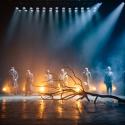
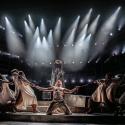
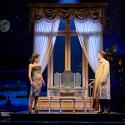
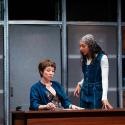
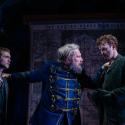
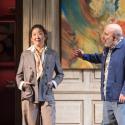
If Jones insists that we hear Berlin's music and lyrics anew, it quickly becomes clear from the wide but shallow rectangular set courtesy of Ultz, complete with a travelator on which an entire miniaturist American landscape seems to parade by, that we must see the show afresh: perversity being a Jones trademark, the show often looks as if it is being energetically performed within some sort of low-lying barn or (at best) high school cafeteria. That in itself helps explain the, uh, "choreography" of Philippe Giraudeau, which during "Sun In the Morning" finds the company leaping about antically like an unruly class that has gone out of control.
And yet, just when one thinks Jones is having fun at the expense of material that may simply be too four-square for his macabre tastes (Jones's brilliant Metropolitan Opera Hansel and Gretel lies more obviously within his comically grotesque comfort zone), a funny thing happens. A gathering sweetness overtakes proceedings and Berlin's score does the rest, leaving buffs to clock the witty scenic homage after the interval to Jones's lone Broadway musical credit to date: the Tony-winning show, Titanic. (Clue: it occurs during a trans-Atlantic crossing.)
 The evening's Annie Oakley, the eternally elfin Jane Horrocks, couldn't resemble less such previous occupants of this role as Kim Criswell and Reba McEntyre, not to mention Ethel Merman, who originated the part with a voice that could shoot to kill without need of a gun. Marking her first actual stage musical gig since the Donmar Cabaret, Horrocks lays on the facial tics and grimaces a bit thick, as if to suggest that Annie Oakley was not only illiterate but not altogether there. But that's before one connects up the stars and stripes enfolding the Vic auditorium - America blanketing the audience on all sides - and the way in which Horrocks's Annie embodies a certain sort of abiding American impulse: eager, feisty, impetuous, and none too good with foreign names. Italy in Horrocks's hillbilly rendering of the word becomes "Iterly".
The part is a hefty sing, and how, which Horrocks gets through largely by channeling one or another of her Little Voice great ladies of old, Judy Garland especially. If the result comes across as an extended impersonation, the actress also looks as if she is having a blast, which in a piece of this sort is crucial. Sporting braids and a Mickey Mouse T-shirt at the start, she's lucky, too, to be paired with the Frank Butler of Julian Ovenden, the creamy-voiced alumnus of the Donmar's Grand Hotel and Merrily We Roll Along, who need only lighten the slickness to turn this into the star-making vehicle that he has long deserved. (And that at times he jocularly insists this assignment is, the actor luxuriating in a vocal prowess that leaves the rest of the company back in, well, Ohio.)
The British playwright April de Angelis is credited with "additional dialogue", which presumably had something to do with the droll reconsideration of the Indian - make that Native American - component of a Herbert and Dorothy Fields book that has confounded Broadway veterans in recent years: Niall Ashdown's Sitting Bull gets a delicious, if fleeting, moment of self-explanation. On the one hand, this Annie Get Your Gun seems to want to overhaul its source or at least force a reassessment of it. On the other, it has its cheeky way with material that doesn't run too deep and then knows when to stand back, namely when the dialogue stops and these characters once again express themselves in gorgeous, impassioned, and timelessly appealing song.