By all accounts Eric Gill had a shocking private life. When it was revealed in Fiona MacCarthy’s biography, published 20 years ago, that he’d embarked on an adult incestuous relationship with not only both his of sisters but, later, with two of his teenage daughters (the family dog didn’t escape his attentions either), there were demands from some Catholic churchmen for the prompt removal of his carved stone altarpieces.
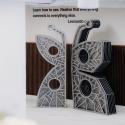
 But as much as Gill’s personal life appals and fascinates, we are schooled to separate the artist from the person, and this is what the Royal Academy’s riveting exhibition of three modernist masters of British sculpture achieves. Ignoring salacious detail, we’re given only a sober account of Ecstasy (1910-11, picture right), which depicts in Portland stone relief, and with elegant simplicity, Gill’s sister Gladys making love to her husband, portrayed from a life "sitting". Unsurprisingly shocking for its time, Gill’s London gallery, the Chenil Gallery in Chelsea, decided against putting the sculpture on display for his first solo exhibition in 1911, though the it did not languish in obscurity: it was bought by Edward Warren, an English collector who’d commissioned Rodin’s The Kiss some years earlier.
The first gallery in the RA’s exhibition is devoted to Gill, with the second to Jacob Epstein and the third to Henri Gaudier-Brzeska, the trio of young, radical sculptors – the latter two émigrés from New York and Orléans, respectively – who transformed British sculpture in the decade leading up to the First World War. This they did by returning to the art of carving directly in stone in a manner that evoked primitive and ethnographic art. And what strikes you about this first room, which belies anything you might assume of Gill as monstrous abuser, is the sensual tenderness, the almost sweetly sentimental eroticism that pervades much of his work, from the explicitly sexual to the overtly religious. Austere in their economy of execution but voluptuous in form, his numerous free-standing Mother and Child figures, for instance, convey both a sense of the devoutly holy and the earthily seductive.
Gill’s carvings are executed with a pared-down economy that make him truly modern, yet they possess none of the charged aggression and forceful energy of the work of either Epstein or Gaudier-Brzeska. They are objects of stillness and serenity, and even in Boxers (1913), a relief in which we see two young naked boys engaged in the tense embrace of two fighters, there is a sense of a sombre, slow, ritualised dance, which is more suggestive of tender foreplay than of sweaty physical combat.
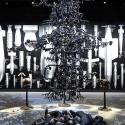
 As bold as Gill was, Epstein was bolder and more radical still, and it is he, rather than Gill, with his traditional, return-to-medieval craftsmanship, who can be said to be the true father of British Modernist sculpture. In the second gallery we are confronted by the striking figure of the Rock Drill (picture left), seen here in its original full-length form (recreated in the 1970s). A sinister, helmet-faced robotic figure straddles a real rock drill, and in a perversion of the traditional theme of mother and child that Gill was so attached to, this dehumised figure carries within its open abdominal cavity an upright foetus. It is a breathtakingly audacious piece of work, more powerful and fearsomely majestic than the slightly later truncated figure of the Rock Drill we see beside it, cast in bronze and minus legs and drill. The original was completed in 1915. No other British sculpture of the period conveys such a brutal sense of the technological armeggedon of the First World War.
It was a war that, earlier that year, had killed his 23-year-old friend Gaudier-Brzeska, whom he had met in 1911 and for whom he acted as a mentor. The gallery devoted to Gaudier-Brzeska recalls the primitivist and totemic work of Brancusi, yet with even greater animalistic energy. His Portrait of Ezra Pound (1914) portrays the poet as an abstracted totem carved in rough-hewn wood that suggests a overpowering and brutish individual, and his iconic Red Stone Dancer (c.1913) radiates a kind of orgiastic force.
Both Epstein and Gaudier-Brzeska were the true revolutionaries of British sculpture, but never for a moment does their work in this exhibition overshadow the subtle work of Gill, an artist who is rarely exhibited in their company. The exhibition does, in fact, strikingly illustrate the divergent forces of British Modernism, but in a way that is beautifully and mutually complementary.
Wild Thing: Epstein, Gaudier-Brzeska, Gill continues at the Royal Academy until 24 January 2010. More information here.