There are two exhibitions of Cy Twombly's work at Gagosian Gallery right now. One is fine and will detain you for a few minutes. The other is exactly the revelation we want to refresh and enhance Twombly for his afterlife.
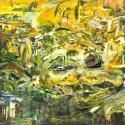
In its main gallery are Twombly's Last Paintings (Untitled, pictured below), given the titular terminal reverence of something like Strauss' Four Last Songs. The mere title suggests the paintings have a life-summing profundity, that last works are last works because the artist uses them as the deliberate culmination of a lifetime's thought, not because the artist happens to die after putting his brush down. (Twombly's later paintings are already being given reverent treatment at Tate Liverpool, while the Dulwich Picture Gallery recently hung him next to Poussin.)
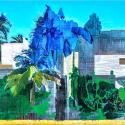
The faded colours and lack of precision seem terribly modern - Twombly as patron of the Instagram generation
Happily, the paintings survive this portentousness and indicate the liveliness and passion of an artist still experimenting rather than constructing his mausoleum. Great red and orange and yellow loops of paint charge across a lime-green background, the paint being put on in such profusion and with such energy that drips dribble down the canvas, and they provide the true animation: these thin straight lines delicately contrast with the swirls above, suggesting different planes and rhythms and a much greater sense of design than you might otherwise perceive. The fact that he lets each colour dry before slopping on the next one also belies the chaos.
The name of the series, Camino Real, suggests Freud's "royal road" to the unconscious, dreams, which adds to the elemental psychological feel. Is Twombly painting his dreams? Is he dreaming as he paints? Is painting the proper way to access the psyche?
 So these paintings are good - but the photographs taken by Twombly in the next room are great. More than great, spectacular. Never before seen in the UK in such number, they are of ostensibly ordinary subjects: peonies and tulips, classical sculptures, forests. What Twombly does with them, however, adjusting their focus so that they are blurred or blotchy, reveals so much about how he saw the world and why he came to paint as he did.
Take the photo of one of Robert Rauschenberg's Combine sculptures in his studio (1954): nothing is clear, the combine emerging in black blotches like a ink pen flicked at the photographic paper, the studio in blinding white patches. The out-of-focus Peonies (1980) or Tulips (1985) may be a detail straight from one of his paintings, colourful undefined shapes. (In the retro way we live now, the photographs, with their faded colours and lack of precision. seem terribly modern - Twombly as patron of the Instagram generation.)
The modern photos are the same. Those from St Barth's, taken in the last year of his life, focus on gravestones and the rather twee sincere flowers which adorn them. The close-ups are disorienting, the colours bleached, shapes and edges dissolving into the immaterial. By focusing on a small part of the statue Detail of Neoclassic Sculpture (Gaeta; 1992) becomes a play of lines. With his photos, Twombly was abstracting real life as much as he could, a process which had its direct continuation in his canvases.
Both existing fans and those who find Twombly abstruse will benefit from seeing these photographs, a key to his art and an unusual glance through his eyes.
- Cy Twombly: The Last Paintings/A Survey of Photographs is at Gagosian Gallery until 29 September