The famous count could not have a more theatrical pedigree if he tried. The great actor-manager Henry Irving – tall, preternaturally thin, with a fixed glare (due, apparently, to extreme myopia) and a grand manner which gave way, said Bernard Shaw, to "glimpses of a latent bestial dangerousness" – was, said everyone at the time, the obvious source of the Transylvanian Undead aristo as he was created on the page in Dracula by Irving’s business-manager Bram Stoker.
TR Warszawa, too, has a theatrical pedigree. In London the company appeared two years ago to acclaim in Sarah Kane’s 4.48 Psychosis. That play is spare, fragmentary, with no plot, no characters, no firm commitment, even, to how many people are performing in it. With Nosferatu (using the title of FW Murnau's 1922 German Expressionist film of Dracula, renamed for copyright reasons), director-writer Grzegorz Jarzyna has gone to the other end of the spectrum, with a story and characters so well known they barely need retelling.
The momentum of the evening pulses slowly, and in unequal waves
So he doesn’t. And he does. There is a certain amount of narrative continuity, but for the most part the evening (110 minutes with no interval) carries through in a series of set-pieces followed by blackouts, with more or less narrative cohesion. (Not aided on the first night by tetchy technical problems: mikes that were so omnidirectional it was difficult to know who was speaking, surtitles that were badly placed or, occasionally, missing.)
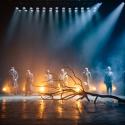
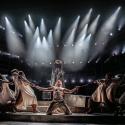
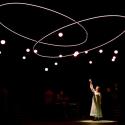
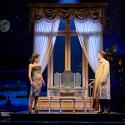
The single set, a multi-functional art-deco-ish room in underwater blue with fluid mirrors and lighting (set by Magdalena Maciejewska, lighting by Jacqueline Sobiszewski), indicates the updated nature of the story, as do the opening lines, an only intermittently comprehensible account of neutrons and particles and abstractions like ‘The past is trapped in eternity’.
 Lucy (Sandra Korzeniak) is predatorily circled by three men (as well she might be, as she marches across the stage dressed only in crotch-high t-shirt and stilettoes). She chooses one, but the others remain even as she wanders out into the night. As we all expect, soon comes the stranger at the door, and here Jarzyna settles for high camp: "I never drink – wine," he demurs.
Nosferatu is played by German actor Wolfgang Michael, his accent setting him apart, consciously, as the Other, the Stranger. Yet unlike Stoker’s suave demon, this Nosferatu is a small, slightly off-centre, awkward man, a man no one is naturally drawn to.
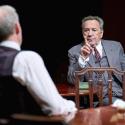
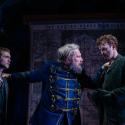
All the more dramatic, therefore, is the scene after Lucy’s death, when she feeds off his body (a tastefully – if that is the right word – discreet scene of fellatio). Here is the charge and the eroticism that has been lacking in the somewhat languid production until now. Indeed, Jarzyna’s dramatic strength lies in moments where just two people confront each other: similarly, Nosferatu’s final scene with van Helsing (the charismatic and velvet-voiced Jan Frycz) is also ratcheted up to the limit.
 The dialogue, at least in its English translation, ranges from incomprehensible abstractions through snatches of quotations – "the sleep of reason brings forth monsters" – to truly chilling moments: "You will never see your face again." "I’ll see myself in the faces of others." "Yes, as their life drains away." "That’s always the part I like best."
The momentum of the evening pulses slowly, and in unequal waves. There are long, liquid scenes of atmosphere, interspersed with tightly-coiled drama, or homages to silent film (including Mina tied up as though ready for placing on a railroad track, even as she is faced with a hypnotist dangling his pocket-watch).
It is lighting and style that give a sense of coherence, rather than plot and character, as Anglo audiences are more accustomed to. But Jarzyna’s TR Warszawa is the real McCoy. The evening is not, perhaps, the most fun you can have with a fang, but the deep veins are worth sinking a tooth into.