An award for artists whose work engages with "social reality, lived experience and the human condition" has been won by a Mexican forensic technician whose works deals intimately with her country’s brutal drug wars. Britain’s most valuable art award to a single artist, the Cardiff-based Artes Mundi Prize, saw nominees this year from Cuba, England, India, Lithuania, Slovenia and Sweden. But the winning works by Mexico’s Teresa Margolles were the ones that responded most directly and dramatically to the competition’s challenging premise.
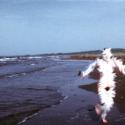
One involves water used to wash corpses in a Mexican morgue; another incorporates tiles from the floor on which a friend of the artist’s was murdered. Yet anyone expecting explicitly violent imagery or easily comprehensible messages will be disappointed. At first sight, Margolles’ (pictured above with her installation 32 Anos) work is cool, minimal, with no obviously political content. One of her key works, Plancha, is a series of floor-based hotplates onto which water drips, evaporating on impact. 32 Anos is simply an anonymous stretch of floor.
She believes drugs aren’t the sole cause of this violence. 'The inequality of Mexican society has a lot to do with it'
"When you work with horror you have to reduce it to something very simple and clean so that people don’t just run away," says Margolles, who trained in photography at Mexico City’s National University, before taking a diploma in forensic technique to gain access to the country’s morgues. "I come from Sinaloa in northern Mexico, which is an extremely violent city. Everyone there has a friend or family member who has been murdered. I wanted to understand more about what comes out of that. I came to realise that the morgue is a social thermometer. What happens inside the morgue reflects what’s happening outside."
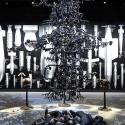
In Plancha (pictured below), water that has been in direct contact with the corpses of murder victims goes through a transition between being something and nothing as it hits the hot plate and evaporates. In 32 Anos the tiles on which the 32-year-old artist Luis Miguel Sero was murdered in his home by thieves are brought into the physical proximity of the viewer. In Sonidos de la Morgue the gallery visitor listens on headphones to the sounds of a scalpel tearing through human organs during an autopsy.  "Since I started working in morgues around 1990 I’ve seen a steady increase in the number of corpses and a worsening of their condition," she says. "Many are now mutilated." Yet she believes drugs aren’t the sole cause of this violence. "The inequality of Mexican society has a lot to do with it."
At 49, Margolles is the second oldest and one of the best known of the nominees. While the award, open to artists anywhere in the world, doesn’t make any stipulations concerning age, artists are expected to be of "growing importance" in their own countries rather than major international figures. Apart from India’s Sheela Gowda, who is in her fifties, all of this year’s seven nominees are in their forties, and five are women.
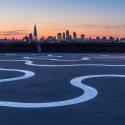
The host country Wales didn’t figure among the nominations. The nearest thing to a local boy was sometime Turner Prize short-listee Phil Collins, who hails from just over the border in Cheshire. His contributions to the exhibition of nominated artists’ work include a fictional TV shopping channel in German in which viewers are invited to participate in a porn video in Victorian costume. Cuba’s Tania Bruguera, whose previous works include a live installation with mounted police in Tate’s Turbine Hall, is showing only one video in the exhibition, preferring to take her work, on the subject of immigration, to the streets of Cardiff.
More than 30,000 visitors have already seen the show at Cardiff’s National Museum Wales. The biennial prize, now in its fifth incarnation, comes with a purchase award of £30,000 from the Derek Williams Trust allowing a work by one of the shortlisted artists to be acquired by the museum.
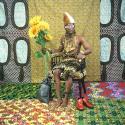
The nominated artists were Miriam Bäckström (Sweden), Tania Bruguera (Cuba), Phil Collins (England), Sheela Gowda (India), Teresa Margolles (Mexico), Darius Mikšys (Lithuania) and Apolonija Šušteršič (Slovenia).
The Artes Mundi International Exhibition continues at the National Museum Wales, Cardiff, until 13 January