The idea of making the princely hero of Cinderella a preening, vacuous lead character from some BBC Three-style reality show is a good one. These days the notion of a smart, self-respecting young woman limiting her horizons by playing accessory to a standard-issue posh bloke is ripe for subversion. Best to turn the entire concept on its head and have a little fun with it.
Which is precisely what Johnny McKnight’s retelling of the classic Cinderella story attempts, to sadly limited effect. It begins with a young Cinders scattering her Mum’s ashes around a blossom tree, and throughout is weighed down by a near-fatal misjudgement of tone. Lingering far too long around the edges of genuine cruelty, emotional pain and sexual game-playing, in the process it all but forgets that it's primarily here to provide family entertainment.
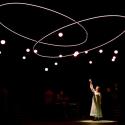
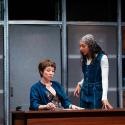
 The mother in McKnight’s version becomes a fairy godmother, swinging prettily above the stage and dispensing maternal wisdom at moments of crisis. Her arch enemy is the wicked stepmother Monique La Mort, a supernatural old witch who derives pleasure and power from channelling the unrequited love of men, a concept six- and seven-year-olds may not be best placed to grasp. After putting a violent spell on Cinderella’s father to boost her waning powers, she moves in, accompanied by her daughters, two garishly grotesque lassies in lycra (pictured right). While they clomp about farting and saying "Newsflash!" a lot, Cinderella is rapidly banished to the garden.
The La Mort clan have come to Paris to seek out Prince Pierre, a bleach-blonde low-brow media sensation forced into finding a wife among the local populus in order to stop the channel pulling the plug on his ailing reality show. Less genuine blue-blood and more Made In Chelsea material, not only do the sisters lust after Pierre, but Mama wants a piece of him too. Indeed, his hunt for a suitable marriage candidate comes with several twists on tradition: the prince is entirely resistant to the idea of finding a spouse; the pumpkin carriage is now a moped; instead of a ball the women are invited to an intimate supper with champers and snails. Although Cinderella fancies Pierre when he's plastered all over the pages of tacky sleb mags, once she gets up close she discovers his charms are less appealing. After much convoluted manoeuvring, it transpires that her handsome hero isn't destined to be Pierre at all, but exactly who we expected it might be all along.
 There’s nothing wrong with the acting. Performing with rude gusto, as ugly sisters Camille and Colette Jo Freer and Nicola Roy are suitably, hideously OTT, though their shtick fails to resonate with large parts of the audience. As the self-styled Destroyer of Love Jayne McKenna literally crackles with evil. Martin McCormick has fun as Pierre, whose best friends have become a TV camera and a boom mike, though as his PA Bumble the excellent Grant O’Rourke feels somewhat underused. There is also some touching interplay between Julie Heatherill’s sparky Cinderella (pictured left) and Boy (a mute version of Buttons, played with skill and charm by Spencer Charles Noll).
Alan Penman’s songs are generally strong and memorable – especially “Breathe” and “A Little Bit of Magic” – but as both a satire on the culture of empty celebrity and a rather dark celebration of the self-sacrificing nature of true love Cinderella suffers from an almost terminal absence of festive fizz. The plot is unfocused and the tone oddly pitched for its core audience. At the performance I attended no one was booing or screaming, and there were mere titters rather than raucous laughter. Sure signs all that the seasonal magic is misfiring.