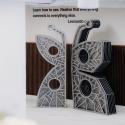
Richard Wright's work celebrates impermanence but his election last night as the 2009 Turner Prize winner - an award which brings with it a purse of £25,000 - has guaranteed it a sort of immortality. The Glasgow-based painter's major piece currently on display at Tate Britain is an enormous, luxuriant and ornate symmetrical fresco painted in shimmering gold leaf which commands the otherwise virtually empty room it occupies.
Wright's is the most traditional of the four shortlisted shows at the Tate Britain. Conceived in response to the parameters of each individual space (a video on view at the Tate records other examples), his art is intended as ephemeral: the current piece, painted directly on the wall - a process which took four weeks - will disappear forever when the show ends in January. Meanwhile, to appreciate its serene classical impact fully, you'll need to rise early, and repair to Millbank before the gallery clogs up with noise and bodies.
The centrepiece of the display fielded by Roger Hiorns, the hot favourite for the award, is a jet engine atomised into metal powder and shaped into a dramatic lunar landscape which occupies virtually the entire floor of the show's last gallery. Hiorns has also attracted much attention and acclaim for Seizure, his spectacular installation in South London in which he turned a condemned council flat into a magical, yet somehow toxic blue grotto, covered in live crystals induced with a copper sulphate solution. (Seizure is open until 3 January).
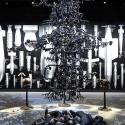
Of the two remaining shortlisted candidates, Lucy Skaer exhibits a group of 26 replicas of Brancusi's Bird in Flight, made from coal dust and resin (an installation which looks to my mind a bit like skittles), but her gallery is dominated by the huge, beautiful and mysterious skeleton of a sperm whale which is secreted in a walled gallery and visible only in segments through a series of slats. Enrico David's Gothic puppet show is a sort of perverted children's playroom, a black area populated by bizarre and grotesque figures made of cloth and papier mache.
The Turner Prize Exhibition continues at Tate Britain until 3 January. Click here to read theartsdesk review
The centrepiece of the display fielded by Roger Hiorns, the hot favourite for the award, is a jet engine atomised into metal powder and shaped into a dramatic lunar landscape which occupies virtually the entire floor of the show's last gallery. Hiorns has also attracted much attention and acclaim for Seizure, his spectacular installation in South London in which he turned a condemned council flat into a magical, yet somehow toxic blue grotto, covered in live crystals induced with a copper sulphate solution. (Seizure is open until 3 January).
Of the two remaining shortlisted candidates, Lucy Skaer exhibits a group of 26 replicas of Brancusi's Bird in Flight, made from coal dust and resin (an installation which looks to my mind a bit like skittles), but her gallery is dominated by the huge, beautiful and mysterious skeleton of a sperm whale which is secreted in a walled gallery and visible only in segments through a series of slats. Enrico David's Gothic puppet show is a sort of perverted children's playroom, a black area populated by bizarre and grotesque figures made of cloth and papier mache.
The Turner Prize Exhibition continues at Tate Britain until 3 January. Click here to read theartsdesk review