The pronouns have it in Alan Ayckbourn's career-defining comedy of spiralling misunderstandings, which has arrived on the West End 46 years after first hinting at the formidable talent of a dramatist who could make of many an "it" and "she" a robustly funny study in two couples in varying degrees of crisis. Far nervier than its study in middle-class mirth at first lets on, Relatively Speaking hands Felicity Kendal her giddiest stage assignment in years, and she is well served by a Lindsay Posner staging that once again gives Ayckbourn pride of place: the man of the moment (to co-opt one of his subsequent titles) as alert on domestic malaise as he is attuned to a surefooted craftsmanship that holds up, and then some, all these years on.
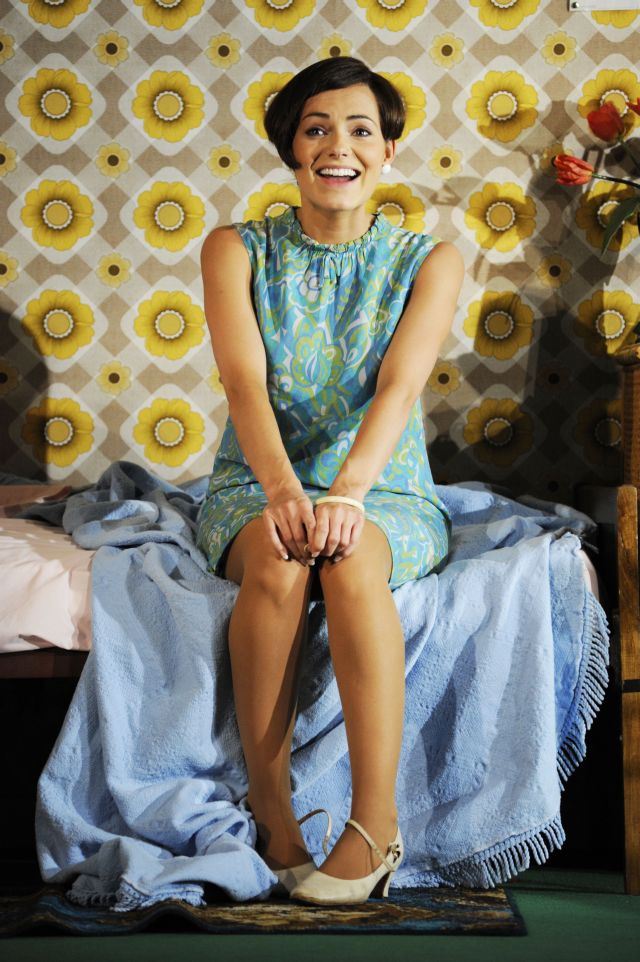 A portrait of two partnerships - one but a month old though already on the road to marriage, the other well-established and near the point of ruin - Relatively Speaking takes an apparently simple conceit and pushes it to a perilously funny extreme. The loved-up Greg (a sweetly oblivious Max Bennett) decides to pay a surprise visit on the parents of the bewilderingly evasive girlfriend, Ginny (Kara Tointon, pictured above, her look to the Mary Quant manner born), whom he hopes to marry. Instead, a well-intentioned train journey to deepest Buckinghamshire lands Greg in the garden of a long-married couple who haven't the faintest idea who he is and won't until many a slow burn and double take have come to pass. And some while after "daddy" has acquired various meanings well beyond the merely paternal.
Husband Philip (Jonathan Coy, splendidly splenetic) knows Ginny all right, not as a daughter but as his ongoing mistress in an affair that the young newlywed-in-waiting wants to bring to an end. Ginny's plans, in turn, fail to account for Philip's beamingly ditzy wife, Sheila (Kendal), who is erroneously taken to be the randy Greg's intended, thereby fulfilling Philip's deepest suspicions about his chipper if possibly none-too-faithful spouse. "I've mislaid the hoe," snarls Philip in a cascading fury at events that find errant garden implements to be the least of his worries. Ginny arrives in time for Tointon to further furrow her brow, the actress as voluble here as she was (deliberately) sullen and indrawn a season or two ago in the same dramatist's Absent Friends.
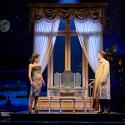
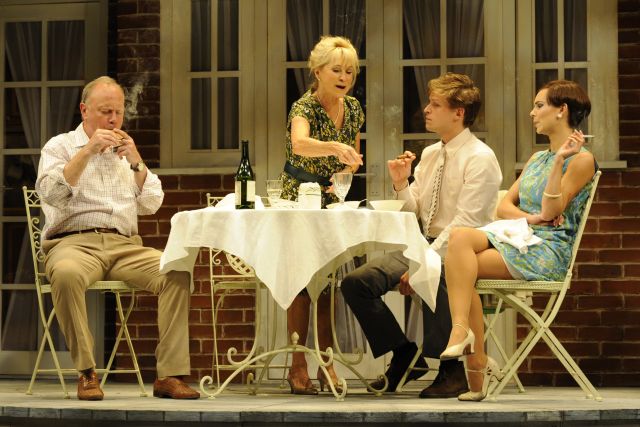 A short play (less than two hours, interval included) is a marvel of construction that effortlessly folds the pressure of symmetrical train journeys into a city-vs-country gavotte that nods glancingly to Wilde while anticipating the far darker forays into the partnered psyche that would go on to be Ayckbourn's proven terrain. What enchants as well on this occasion is the period modishness of Peter McKintosh's poster-perfect design - Breakfast at Tiffany's on the lovers' London wall, the lunch from comic hell on the suburban menu - set against our burgeoning sense of Sheila as possibly the most astute figure on a greenery-bedecked stage on which Kendal is forever bustling about, proffering refreshment as the realisations come home to roost (the four actors are pictured above.)
Looking over her shoulder as if expecting some better, more truthful existence to make itself known, Kendal hasn't been this well cast in ages, her signature winsomeness replaced by a deliciously dim aspect that is itself shown to be far from the whole truth. And what will happen in the sequel to events that Ayckbourn didn't write? For all the chatter about the summer sun, one senses storm clouds brewing. This is Ayckbourn territory, after all, which means that happiness is only relative. Give these people and their playwright time, and make way in due course for madness.