Imagine the rising and falling piano cadences of Gershwin’s Rhapsody in Blue. Then plug the gaps between each note with any of those which may have been encountered on the path to the next. Once that’s done, ensure that the playing is constant with each note bleeding into the next. Mesh the result with a similar composition played at the same time and you have some idea of how Lubomyr Melnyk’s “Windmills”, his final piece last night, sounds.
Melnyk’s precise music – what he calls “continuous music” – bears some relation to a few minimalist pianists: Charlemagne Palestine comes to mind. But Melnyk’s playing ranges so widely across the keyboard and his more lengthy compositions are so elaborate that minimalism hardly seems an appropriate handle for his work. As “Windmills” progressed, the sound built like waves inducing a feeling akin to a sonic seasickness.
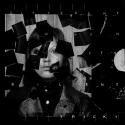
 While Melnyk harvested intricate patterns, he shared the stage with Gregory Euclide, the American artist whose painting is seen on the cover of his most recent album Corollaries (pictured right). Euclide spent the hour of the concert creating a new work from scratch.
Euclide began by spraying a white board with water. Using brushes in time with the rhythm of the music, his wrists and arms became a metronome. The black paint applied dripped down the wet surface as he slashed arcs through the streaks. Images emerged: trees, the surface of water, buildings and valleys. It was recognisable as the work of the artist chosen by Bon Iver's Justin Vernon to illustrate the cover of his last, eponymous album. It was also extraordinary. Afterwards, Euclide said he began with no idea of what he was going to paint.
The music Euclide responded to wasn’t initially as overpowering as “Windmills”. Melnyk began with “Regulator No 12”, which he described as “an easy introduction, a training piece for learning continuous music.” In this simpler, less note-packed form it was easier to hear Melnyk’s familial relationship with New York minimalism.
Yet when that was making waves in New York, Melnyk was following his own path in Canada. Of Ukrainian extraction, he was born in Germany in 1948. His parents moved to Winnipeg in the 1950s. After time in Paris in the early Seventies, he returned to Canada and evolved his continuous music, where rapidly played and contrasting arpeggios created overtones resulting in additional melodic elements. His first recordings emerged in 1979.
'The FASTEST pianist in the world sustaining speeds of over 19.5 notes per second in each hand'Berlin and London-based imprint Erased Tapes issued Corollaries, a series of short, collaborative pieces. As his new home, the label makes sense as it has also released material by similarly-minded, not-easily-pigeonholed Ólafur Arnalds, Nils Frahm, Peter Broderick and A Winged Victory for the Sullen, all of whom spring off from minimalism. The only difference between these and Melnyk is the at least 30-year age gap.
Melnyk is methodical. He categorises his music as four styles: M-1 (“very melodic”); M-2 (“somewhat melodic”); M-P (“mixed periods, melodic pattern”); and P-1 (“mainly pattern and chordal sustained sounds”). He’s also not shy. His “pianistic achievements” boasted on his website (its capitalisation intact here): “the FASTEST pianist in the world sustaining speeds of over 19.5 notes per second in each hand, simultaneously and the MOST NUMBER of NOTES in ONE HOUR in exactly 60 minutes, Melnyk sustained an average speed of over 13 notes per second in each hand, yielding a remarkable total of 93,650 INDIVIDUAL notes.”
Running the brow-furrowingly analytical in parallel with such boldness suggested Melnyk could be as much showman as highbrow artist – not a criticism, more a thought that the music might be overshadowed. It does, though, also confirm his lack of tolerance for boundaries, a trait underlined by last night’s close bond between Euclide and what he was hearing. In the event, terminology and accomplishments were irrelevant. With this performance, Melnyk transfixed.
Watch the trailer for Lubomyr Melnyk's Corollaries tour