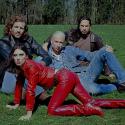
“It’s a good way of letting of steam,” said Reda Allali, the lead signer from Morocco’s leading rock band Hoba Hoba Spirit, referring to the the Timitar Festival. “It’s a step in the right direction anyway – although there are many steps ahead.” The Timitar Festival in Agadir, which finished last night, is at the root a celebration of Berber culture, a culture that has been historically undervalued in these parts, even though the majority of Moroccans are Berbers and are the indigenous population, the origins of their music and artistic expression going back millennia. There have been Berber rebellions in Algeria and elsewhere, and even last year the Touregs, who are mainly Berbers, attempted to establish an independent state (which was hijacked by the Islamicists) in Mali.
The Festival may be as some see it like Saharan-Berber singer Malika Zarra, now based in New York, a bread and circus distraction (“They had to do it,” asserts Zarra) but it’s also true the authorities here are cannier and more flexible than their more blatantly repressive regimes elsewhere, and one reason why the country seems so much more stable than its North African neighbours (another reason is the unifying force of the seemingly universally revered King).
Now in its 10th year, the Festival with up to 500,000 spectators over four days has been part of a welcome accommodation, acceptance and finally celebration of Berber culture that has been developing in Morocco in the last decade. There is finally a Berber TV channel, the language is being taught in schools and the new constitution in 2011 recognised Berber as an official language.
Other songs are about the identity confusion of young Moroccans caught between traditional, Islamic and modern European and American influences
As Allali (see Hoba Hoba Spirit video, next page) said backstage after they had rocked the huge crowd at the beach-side Place Bijaouibe venue - they were in a country where rock could still really change things. The singer was hugely influenced by French band by seeing the French band Mano Negra as a student. Their subversive post-punk energy mixed with Hispanic and Arabic elements was an inspiration (Mani Negra were Manu Chao’s first breakthrough band). “In London now, unlike in the Seventies, everything seems to be permitted, so nothing can shock people.” He admits it’s an enjoyable game “walking a line” – but “I was surprised to hear us singing a song 'Will to Live' which is a setting of a poem written in the Forties” – the song became an anthem for the demonstrations in Moroccan which occurred a couple of years ago. Other songs, like "Marock'n Roll" (inevitable title) and "Gnawa Blues" show the influence of local music, while others talk of the identity confusion of young Moroccans caught between traditional, Islamic and modern European and American influences.
Elsewhere, in the large open-air Theatre de Verdure the great Lebanese oud player and singer Marcel Khalife and his group were singing songs which have become associated with the struggle in Palestine, revolutionary songs of dignity, and assertion which the Moroccan crowd knew. I’ve never actually never seen such audience participation – often the audience would realise what the song was and sing a verse or two before Khalife and his band joined in.
The biggest venue was the Place Al Amal, where the really big crowds (over 60,000) would congregate for artists like the charismatic Idir, who is a kind of Algerian Bob Marley. Many of his songs were of the suffering of the Algerians, in particular the Berbers there, from heart-rending ballads to easy-on-the-ear fast paced rockier numbers.
At the core of the Festival were local Berber singers like Fatima Tabaamrant, who spent her childhood in the Anti-Atlas, and whose life story of losing her mother and being abused by her step-mother is well-known here. Other local stars like Inouraz and veteran group Oudaden were pioneers in the Berber revival and accordingly revered by the audience. Ribab Fusion were rather more contemporary pop Berber cross-over artists.
In the end, though, the audience were here to party as well, and went bananas to huge artists like Nass El Ghiwane (“the Rolling Stones of Morocco”) as well as Khaled, the rai star who is having one of the biggest hits of his career with “C’est La Vie” (18 million hits on YouTube). That was, incidentally, produced by Moroccan DJ Red One, who has also produced Lady Gaga and has a studio in Tétouan in the north of the country – showing that Morocco is not just about superb traditional music or fusion music or old-style rock, but is also involved with cutting-edge pop.
Morocco, anyway, is becoming a leading specialist in music festivals. Apart from Fes, which appeals to a slightly older and more highbrow crowd, and is a top world music festival, there’s the funkier Gnawa Festival in Essaouira down the coast which brings in Woodstock-sized crowds and a massive pop Festival Mawazine in Rabat, which this year starred Rihanna, not to mention the snappily named Jazzablanca in Casablanca (and another top jazz festival in Tangier). They may be a way of letting the world know Morocco is a relatively tolerant country open to all-comers and a useful distraction and source of employment for the population but they are also inspiring celebrations of fascinating world-class music.
Follow Peter Culshaw on Twitter