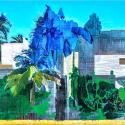
It’s a huge cock! The Brits love double entendres. Maybe the Germans do too, but the Brits have cornered the market. Katharina Fritsch, the German artist behind the huge cock on the Fourth Plinth in Trafalgar Square, has certainly played to our humour, but says she didn’t give a thought to the idea that the cockerel is a symbol of France. Hence, one giving the eye to Nelson, in the square that’s named after his decisive victory in 1805, might give it a double frisson, and perhaps even ruffle a few feathers – though you’ve got to be an incredibly stuffy bore not to enjoy that sense of friction. What is art for if it can’t tickle you in “inappropriate” places?
What’s more, it’s in Gallic blue – though it could be a Royal Blue or a Tory blue or just plain blue. It’s a beautiful colour, and looks amazingly vibrant – a shock of blue of the most intense hue against a pale summer sky. And its size, as tall as a double-decker bus, adds an element of the surreal – you half expect a big Monty Python foot to come along and squash it.
Fritsch is a wonderful artist, as anyone who knows her body of work will testify. This, she says, is her feminist statement – the poking fun at masculine power and the uses to which public plinths have traditionally been put to use. This all sounds incredibly worthy, but the fact is it’s a great piece of public art because it looks great – there’s that joyous double-take when you first see it. It certainly doesn’t blend in with its surroundings, but instead has a dialogue with them, of which there are several possible layers of subtext. And that’s why it’s clever.
Of all the works to win the Fourth Plinth commission in its seven-year history, this one pulls it off most completely. Marc Quinn, with Alison Lapper Pregnant, was surely too earnest – who could really argue with its message? And it was so smooth it looked almost plastic – like a horrible marble resin. But it wasn’t quite as naff as Antony Gormley’s One and Other, which, with its message of inclusivity – oh, please, bugger off – gave show-offs a chance to show off for a whole day in London’s most famous public square.