

Berlioz wanted to make the first arrival of his demon onstage unforgettable, with an extreme sound effect - violins and violas marked sul ponticello, strettissimo, starting fortissimo, with interjections from three trombones snarling in minor seconds. In last night's performance of La Damnation de Faust that moment was glossed over. It flashed past as if it had never happened.
In many of the sections of the work which involved the vocal soloists and chorus, particularly in the first half, Valery Gergiev seldom looked up from his score. It produced a detached reading of the work. He took a more active interpretative involvement - with heavy, unpredictable rubato - in the orchestral showpieces such as the "Marche Hongroise" and the "Menuet des Follets", but taken as a whole, this performance sounded perfunctory. There is a second performance of Damnation on Thursday, and things could obviously improve.
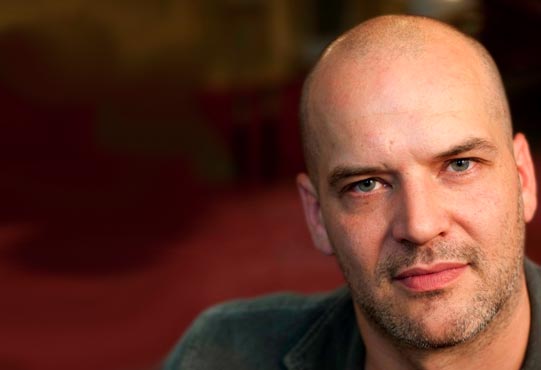
Among the vocal soloists Florian Boesch (pictured below) took the honours with his very brief appearance as Brander, with pointed speech-rhythms and good diction. Tenor Michael Spyres as Faust sang the part from memory, but his French is not always idiomatic, and his portrayal of Faust as the loner, with its long melismas, is not an easy ask, as Edward Seckerson pointed out when Michael Schade took the role with similar forces in 2009.
 It's probably a matter of taste, but I found Olga Borodina's wayward pronunciation of French and her squally vibrato hard to enjoy, and Italian bass Mirco Palazzi does not yet have sufficient authority to lay his stamp on the role of Mephistopheles. The bravos from the chorus at the end of the "Song of the Flea" didn't sound as if they'd been earned. The chorus got better during the course of the evening, but audibility was a problem. "Christ est ressuscité!" didn't just sound joyless, you couldn't hear it.
That said, you can never forget what a fabulous orchestra the LSO is, and what a proud heritage it has in this repertoire, stretching back through Colin Davis and Pierre Monteux and beyond, to Édouard Colonne conducting the Hungarian March in 1904.
To name just a few stand-outs, the handling of filigree string parts from both the firsts and second violins had an astonishing unanimity and telepathy, communicating faultlessly to the back desks. Philip Cobb's low-lying cornet part in "Voici des Roses" was gorgeous (played on flugelhorn?); Sharon Willliams had a fabulous evening topping out the textures on piccolo; and the two orchestral soloists working in Olga Borodina's showpiece numbers - Christine Pendrill on cor anglais and Paul Silverthorne on viola were just stunning. But equally there were, frustrations, moments where Berlioz's clever effects just weren't there, like that deliberate, ominous descent to a low Bb in Rachel Gough's basson part at the end of Act 2, which was inaudible.
It also should not go unnoticed quite how well the hidden parts of the LSO work. The marketers had very nearly filled the 1,850 capacity hall on a Sunday night, with their regular efforts supplemented on this occasion by a strong and clearly very effective Gooogle Ads campaign. And David Cairns' thoughtful and clear programme notes deserve five stars.
However, back to the question of demons. I do not see that Gergiev's political actions should - as some have been arguing recently - place him in the alphabet just above Carlo Gesualdo and Stan Getz as men of musical genius whose lives failed to match their artistry. I owe musical revelations throughout my adult life to Gergiev, but came away from his performance of La Damnation de Faust distinctly underwhelmed.











