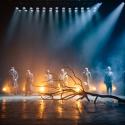
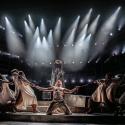
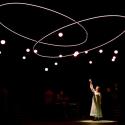
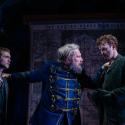
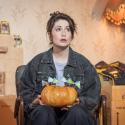
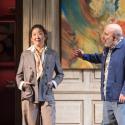
Take a Victorian library and a play which had its premiere 100 years ago and - surprisingly - you have a new arts centre featuring a challenging, dystopian drama. Omnibus in Clapham has exchanged bookshelves for performance and is opening with a celebratory production of Georg Büchner's Woyzeck.
Written when Büchner was only 23, and left unfinished when the playwright died of typhus in 1837, Woyzeck has had an extraordinary influence on dramatists from Brecht to Sarah Kane. It also inspired Alban Berg's intense, atonal opera, Wozzeck, completed in 1925. This year marks both the centenary of the first production of the play, in Munich, and the bicentenary of Büchner's birth - a coincidence director Robyn Winfield-Smith thought too good to miss.
Each director has to decide how the play will end
The story of the poor soldier suffering from mental illness, his humiliation at the hands of those in authority and the unfaithfulness of the mother of his infant child, was suggested by a court case known to Büchner. A man, possibly schizophrenic, killed his landlady in 1821 in Leipzig, claiming that voices had ordered him to do so. He was declared sane and publicly executed. Woyzeck too carries out a murder but his fate is not made explicit because Büchner did not write the final scene. Each director has to decide how the play will end. Winfield-Smith has worked with translator Michael Ewans on the four extant manuscripts, two of them fragmentary, two almost complete, to arrive at Omnibus's version.
Fed solely on peas for six months in an inhumane experiment carried out by the army doctor, Woyzeck hallucinates and is maddened by the obvious attraction between his common-law wife, Marie, and the dashing Drum Major. He has been likened to a proletarian King Lear, a furious tragic figure. Winfield-Smith says that the theme of poverty and exploitation is "totally relevant, given the economic circumstances" but, important as the theme of inequality is, this is "fundamentally the story of a husband, a wife and a lover - and that is timeless". This she plans to render naturalistically, but "with the support of expressionistic flourishes".
 She is aiming "to get to the point where we understand that what Woyzeck hears is the voice of reason for him, while at the same time he is pained that he is following it." The original music composed by Gregory Batsleer is intended to combine naturalistic sound with a hint of what Woyzeck hears in his head.
There will be spectacle too. A troupe of gypsy entertainers visits Woyzeck's village, among them puppeteers guided by Jimmy Grimes, assistant puppetry director on the National Theatre's War Horse. "There will be a horse", says Winfield-Smith, "but nothing like Joey in War Horse."
Isn't Woyzeck a tough option if Omnibus wants to begin attracting a new local audience? Winfield-Smith is convinced that the company's approach is sound, that the production will be seen as celebratory rather than merely bleak. Alongside it there will be numerous events, workshops and other ways for people to get involved and join the discussion suggested by the play.
Woyzeck will be presented in Omnibus's 90-seat studio space, but with the acting area opened up to include the bar. This shows off the original fabric of the building, which first admitted the public some time between the writing of this seminal play and its first performance a century ago.
- Woyzeck at Omnibus, 1 Northside, Clapham Common, SW4 0QW from 19 November to 7 December. To book tickets click here or call 0844 477 1000.