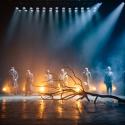
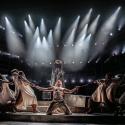
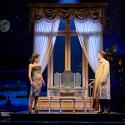
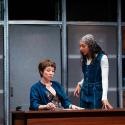
For a play that involves a lot of movement, it is the freeze-frame stillnesses in Athol Fugard’s Statements After an Arrest Under the Immorality Act that linger before the eyes once it is over. Six times bright photographic flashes capture the two protagonists, trapping them, their illicit affair, and their shame, in our gaze for an endless moment. These images are both the climax and the starting point for the drama – it was real-life police photographs of this kind that initially inspired Fugard to tackle this subject.
As in all the best drama, we are aware of the doom that awaits the lovers even while they are lying in each other’s arms, passionately making declarations to each other. For this is South Africa in the 1960s, and the fact that this man is coloured and this woman is white means that their relationship can never exist openly – the Immorality Act of 1957 prohibited sex between races. Even at the start of their affair, Errol and Frieda know that their liaison has a strong chance of ending in arrest and imprisonment (the play’s title tells you all you need to know on that score).
Part of the Jermyn Street Theatre’s South African season, this production of Fugard’s play is taut, brittle and unsettling. The bare planking of the set, augmented only with discarded clothing, a few scattered books and the odd blanket, emphasises the hopeless nature of this relationship. We have no need to see outside – the odd sound effect combined with the vividness of the text is more than enough as Errol Philander describes his dusty walks from his family’s home to the library where his white lover works, and where they meet in secret in the back room.
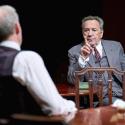
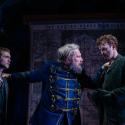
 Statements comes with a warning that it contains nudity, and so it does – both actors are naked for most of the play. When it was performed at the non-racial Space Theatre in Cape Town in 1972, this baring of skin was itself a kind of statement – a celebration of difference and a visual protest against apartheid. Even now, twenty years after the old regime came to an end, it has power. In this production, Jasmine Hyde and David Judge (pictured right with Jack Klaff) also use it to create a feeling of great intimacy. Their partnership on stage is compelling (although the accents occasionally wobble a little), and Hyde in particular excels in the difficult, abstract monologues that come near the end. Perhaps not as well known as Fugard’s other works of the same period like Sizwe Bansi Is Dead and The Island, Statements is still well-worth revisiting.
***
 In 1989, the South African writer Richard Rive was murdered at his home in Cape Town. A stage adaptation of his best-known novel, ‘Buckingham Palace’, District Six, which tells the story of the poor, multiracial community in the area of Cape Town known as District Six, was about to open. Actor Basil Appollis (left) was playing Rive himself, and in this new work based both on the novel and Rive’s own life, he revisits the role. This play, District 6, Our Buckingham Palace (***), is a one-man show in which Appollis, as Rive, tells the story of District 6 and the people who lived there, interwoven with reflections on Rive’s own travels and ideas.
The result is a strange, stumbling stream of consciousness, held together by Appollis’s compelling voice and stage presence. The recollections of “Buckingham Palace”, the row of ramshackle cottages at the foot of Table Mountain where Rive grew up, are by turns funny and affecting, but some of the tales of Rive’s later life and travels drag somewhat, and at times the whole work feels more like a random string of anecdotes than a cohesive whole. That said, there are shafts of brilliance, such as the tale of Rive’s return to Cape Town from abroad and the description of the chilling effect that the three words uttered by the Afrikaner customs officer – “You! Sign here” – had upon him. When the lights go down on Appollis, all is left is the unspoken sadness that Rive never got to take his rightful place as an unchallenged citizen of the new South Africa.