Is the Rose Playhouse London theatre’s best-kept secret? Or simply its worst-publicised? Either way, this gem of a space, tucked away behind the Globe in Bankside, needs and deserves a greater following. If it continues to stage shows like the delicately beautiful Where Late the Sweet Birds Sang however, it’ll be an easy sell. Gentle and melancholic, inventive and profoundly moving – this is a show with a particular autumnal alchemy to it.
The first purpose-built playhouse to stage any of Shakespeare’s plays, The Rose was rediscovered by accident in 1989. Two-thirds of the foundations of the theatre have currently been exposed, but ambitious plans for the future hope to finish the job and transform this magical, liminal space into a fully-excavated site – part living museum, part theatre. Meanwhile a tiny theatre operates on the site, housed in the viewing platform looking down over the foundations. It’s extraordinary – by turns intimate and vast, a space for exploration and experiment, a rugged counterpart to the jewel-box perfection of the Wanamaker Playhouse down the road.
Exploiting the space to its fullest, Martin Parr’s Where Late the Sweet Birds pairs Shakespeare’s sonnets with music for solo cello. Two performers – actress Katherine Heath and cellist Lucia Capellaro – begin in separate worlds of music and speech, but gradually these bleed into one another as a narrative emerges and mutual commentary becomes dialogue, conflict and – eventually – reconciliation.
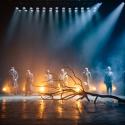
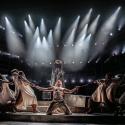
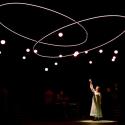
 We open in darkness. Silence gives way to music, as the Prelude from Bach’s G major Cello Suite sounds in the distance. What at first seems an enclosed room is revealed as a balcony. Below a search-light strafes the space, picking out a cellist playing beyond an underground lake – the water-covered foundations of the original Rose. It’s just one of a number of striking visual moments, tableaux that sit just the right side of sentimentality – though a later moment involving a lovers’ dance and some red balloons (pictured left) comes very close.
Action shifts between this distant space and the foreground, where the two women inhabit a domestic space, moving from bed to armchair to table and back again, the huge arc of emotion chafing fruitfully against the physical confinement.
Shakespeare’s sonnets offer the dramatic scaffolding, guiding us through the stages and experiences of love, from dreaming, wanting and waiting to anger and disillusionment. These are short verses but each line is carefully weighted. Hearing rather than reading them is a challenge; these are not poems that dissolve in the ears, but stubbornly refuse to yield up all their meaning. Heath’s declamation is excellent – witty, poised and risky, taking us out of the tidy confines of the sonnet and into more uncertain territory – but even so it’s worth doing a little homework before going. The poems that convey the most are inevitably the most familiar.
Heath has a fine partner in Capellaro – a cellist who also sings (gentle, folky neo-baroque ballads – not a hey nonny in sight) and acts, offering a point of emotional stillness and constancy to Heath’s more mercurial lover. Gradually sonnet monologues become dialogues passed between the two (a device that works linguistically thanks to their shared gender), rewriting familiar verses with unexpected success.
 The influence of director Martin Parr is quietly but pervasively present throughout, at its best in the affectionate eroticism of Capellaro (pictured right), lying in bed with her cello, playing it like a lover (and who knew you could actually play a cello lying down) and exploiting the instrument’s suggestive curves. It anticipates the play’s close – a scene as moving as anything in this fragile show. Abandoned by her lover, Heath sits alone, attempting to draw music from Capellaro’s cello. Capellaro returns and together they reprise the music of the start, transforming a solo into a duet – four hands on one cello. It’s minutely choreographed, a musical metaphor that takes over where the language of Shakespeare’s verse leaves off.
- Where Late the Sweet Birds at the Rose Playhouse until 29 November