Hong Kong master Wong Kar Wai has ventured into new territory with The Grandmaster. Many years in the making, his new film is a remarkable portrayal of martial-arts traditions, specifically the story of kung fu master Ip Man from his early life in mainland China on the eve of World War II, through to post-war exile in Hong Kong. It was there that he set up his own Wing Chun school, which would with time achieve huge international popularity; Ip went on to train future kung fu stars, most notably Bruce Lee.
Fans of the heightened aesthetics of Wong’s early arthouse masterpieces like 2000’s In the Mood for Love will be relieved to know that the final quarter of the film slips back into the more familiar, deliciously melancholy small-scale world of 1950s Hong Kong. Up until then their senses will have been more than sated by some spectacular set pieces that take the martial-arts genre to new levels.
For the kung fu-initiated, 'The Grandmaster' will prove heaven, extolling the form’s full heritage
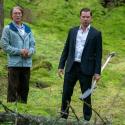
We first encounter Ip (played by Wong’s longterm collaborator Tony Leung, pictured, below right) in early middle age: it’s 1936 and he’s turning 40, living a life of moneyed leisure in the Southern martial arts town of Foshan, his devotion to his discipline seemingly as important, if not actually more so, as his love for his beautiful aristocratic wife.
The set-up for the almost continuous kung fu action of the first hour, much of it played out in heavy rain and with extensive slow motion – who would have thought that a white panama was the headwear of choice for such events? – comes with the arrival of a delegation from the Northern martial arts school, based in the territory of then Japanese-occupied Manchuria. It’s led by Gong Baosen (Wang Qingxiang), who’s seeking one last fight before his impending retirement, though he’s as much interested in investigating and developing younger talent in the field, one which he sees as crucial to the spiritual health of the nation, and in which philosophy is as important as physical agility.
 With Ip selected as Gong’s opponent a master fight follows, one which doesn’t however end to the satisfaction of the latter’s daughter Er (the luminous Ziyi Zhang, pictured, above, who exceeds even her own performance in Crouching Tiger, Hidden Dragon for action agility). She goes for a repeat match herself, and an attraction, unspecified but hanging in the air, develops between the two of them.
But any development of those feelings is broken by the Japanese invasion of the rest of China and the harsh war years, which brings acute deprivation to Ip and his family. When they’re over, he moves to Hong Kong to try and provide for those he’s left behind. When the border closes, he’s stuck there, in poverty, before he opens a school to develop his martial-arts form as a discipline (“kung fu is not a circus act”).
He duly finds Gong Er there again, too, and the coda of this relationship – one in which nothing ever really actually happened – plays out in melancholy silences. Director Wong is absolutely in his old element in these depictions of the down-at-heel locations and atmosphere of early Fifties Hong Kong, its décor matching emotions.
 It all comes in complete contrast to the lavish colours of the martial-arts scenes that have come before, and we get a final, glorious battle in flash-back, set in the wintry North, to drive the contrast home. After her father’s death Gong Er defends his honour against one of his former disciples, the collaborator Ma San (Zhang Jin): it’s an action tour-de-force, fought in a dark winter railway station, as truly athletic – and aesthetic – as anything in the film, or indeed the genre.
For the kung fu-initiated, The Grandmaster will prove heaven, extolling the form’s full heritage, including the many and varied schools like Wing Chun, Bagua, Xingyi and Baji. For the rest of us, there’s a nice exchange between two combatants: “You do mix it up,” one says, querying the other’s apparent combination of genres. “What’s wrong, as long as it works?” the other replies.
Visually ravishing (main lensing by France's Philippe Le Sourd, production design by William Chang and Alfred Yau) and with an almost ever-present score from Shigeru Umebayashi and Nathaniel Mechaly, the film is an explosion of the senses. So much so that we may overlook a story structure that looks a bit patchy, dominated as it is by the set pieces. The closing is as poignant as anything Wong has made: we can only wonder if The Grandmaster will prove a one-off excursion from the style of his cinema to date, or the beginning of a new direction.
Overleaf: watch trailers for The Grandmaster