"You make clothes that make the darkness in me matter": If such an accolade strikes you as profound, make a beeline for McQueen, the James Phillips play about the tortured, all-too-brief life of the maverick talent Alexander McQueen that constitutes the longest 100 minutes I have spent in a theatre in many a month. A shaven-headed Stephen Wight cuts an impressive figure as the designer who is infinitely more compellingly represented at the moment at the V&A, but this play feels like a grubby attempt to trade off his name. Let's just say one can't imagine the real McQueen making it through the pretentiousness on view.
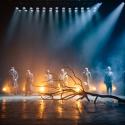
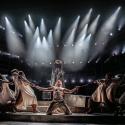
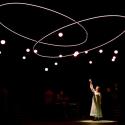
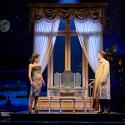
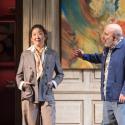
 John Caird's production has reported a record advance for the ever-inviting St James Theatre, and one's heart goes out to any fashionistas drawn to McQueen who may mistakenly think this is what all theatre is like. Staged as a sort of installation complete with video walls and a troupe of catwalk-ready dancers whose affectless expressions give off the impression that they are bored (and who can blame them), the result blends the ponderous and the ridiculous to an unusual degree, and the decision to grant McQueen an onstage foil courtesy of the fictional Dahlia (an unengaging Dianna Agron from TV's Glee) is so clumsy that one can't believe it got beyond the first reading. One might be better off starting from scratch and re-imagining the material, with Wight (pictured above) on board, as a one-man play.
As it is, we get a potted tour through McQueen's scarred psyche in an attempt to claim the Pygmalion story anew - Dahlia even quotes Eliza Doolittle - as it might relate to a onetime clothes-cutter made good who comes to grief and the American apparition on hand to accompany him to his doom.
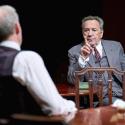
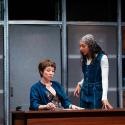
Along the way we get incursions from the likes of the similarly suicidal Isabella Blow (Tracy-Ann Oberman) in a scene of suffocating archness notable mostly for Oberman's affected accent and lots of cod-psychologising elsewhere (the two are pictured below). "You're like a creature from a nightmare, aren't you?" McQueen (who is referenced in the play not as Alexander but by his actual birth name, Lee) asks Dahlia. "Like you're pursuing me, like you're someone I already know" - his inner demons come dangerously to life, perhaps?
 Musical snippets ranging from Handel to Frankie Goes to Hollywood tally with McQueen's own preferences, and the choice of Dahlia as a device finds a point of origin in "The Girl Who Lived in the Tree", his 2008 collection that lives on via the internet as far more theatrical than anything on view here. Indeed, whereas one could easily get lost in the "cabinet of curiosities" section of the Savage Beauty exhibition continuing through the summer at the V&A, this facsimile of the man's world-view and work make one doubly keen to seek out the real thing.
There are moments of savage beauty strewn randomly here and there. One can scarcely fail to be moved by McQueen's visit home to Essex to tend to the death throes of his mum, and his remark that "I love her so much it's like rage" feels appropriate to someone who cut his own life short within weeks of burying the mother he adored.
And Wight - onstage virtually throughout - never relaxes his grip over a man for whom clothing and fashion could be statements of cruelty and aggression, not just ornamental accessories. ("Making stuff .... can save you or it can skin you" is this McQueen's terse assessment of his art.) Might his life have worked as a ballet? (I ask only because I'm sure someone somewhere has the film rights sewn up.) Perhaps. But in the meanwhile we are left with this unfortunate halfway-house, a play-with-movement that for all its blank-faced, ambulatory mannequins remains steadfastly, determinedly inert.