

There’s a clear territorial divide in the small space of the Jermyn Street Theatre at the opening of Ashley G Holloway’s new drama Lesere. At the centre of Ellan Parry’s persuasive design there’s a bright decked area in which the seemingly sunny lives of its characters play out – the setting is the peaceful French countryside, 1921. Around the stage edges, however, is a very different environment, a dark space of silent, agonising memories.
Lesere moves between such light and dark, the latter coming to dominate the action. An English couple, Jane and John, have settled in rural France to put the past behind them and and escape memories of World War One, particularly the trauma of John’s time in the trenches. Their bright, clipped accents indicate that this is prosperous leisure, the vineyards outside to which John periodically retreats a place for therapy through nature rather than labour.
This atmosphere of somewhat forced, co-dependent calm seems to invite disturbance
It’s a life of reading and, in Jane’s case, writing, albeit an isolated one. They’re living in the private world of their affections, while treading on eggshells as they leave war memories off limits in the unspoken hope that time and tranquillity will heal. Cassandra Thomas plays Jane with powerful poise and understated gentleness as the one who’s effectively caring for an invalid, while Leon Williams catches John’s troubled psyche in the apparently inconsequential banter that hints at darkness underneath, and the way he needs repeated reassurance of his wife’s very presence.
This atmosphere of somewhat forced, co-dependent calm seems to invite disturbance, giving the appearance of the play’s third figure, George (Richard Atwill pictured below), dramatic inevitability. It’s always a challenge to make convincing the willingness to admit an outsider who will in due course wreck the status quo: such encounters tend to begin with an affirmation of shared civilities, before the interloper skilfully breaches the lines of defence of those onto whom he has essentially forced his presence.
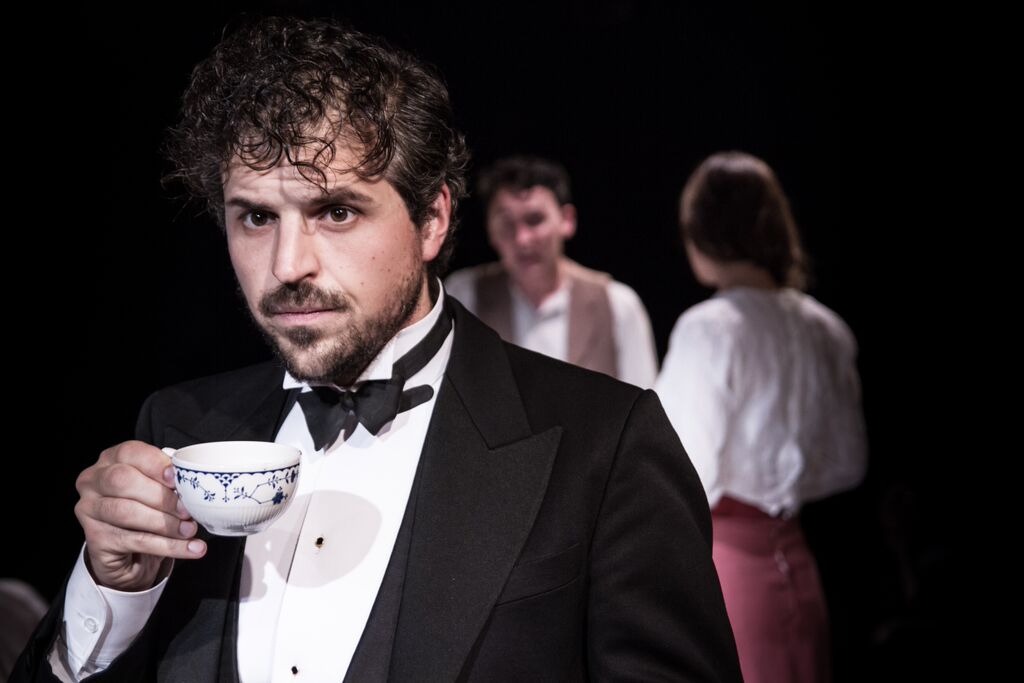 In short, you wonder why the destructive outsider is not simply turned away, with or without civility. In Lesere, George first stumbles into Jane’s presence with a wounded hand, which demands response in itself, while the appearance of another Englishman in their isolated, foreign world predisposes the couple towards at least receptive curiosity. When George returns, this time encountering John, he plays on their shared wartime experience to swiftly assert his dominance over the weaker party.
His control duly dominates, setting up a second half in which the couple are forced to confront their darkest secrets: it becomes psychodrama with the refrain “No more lies” as the elegant surroundings of the opening are literally turned upside down, and the world of the trenches intrudes. Holloway gives it the structure of a forced, formal dinner, with George, whose dress from the outset has (for some reason) been black tie and tails, acting as the waiter who serves up each new course of interrogation. Dramatic tension rises, even as we, the audience, wonder just how George has come to be so familiar with the couple’s innermost worlds (his initial entrée into their lives having come when he purloined a notebook from Jane).
Has something linked their lives in the past? Is George a figure of mystery with simply devilish intuition? Or, as Holloway seems to be suggesting on another level, a perverse kind of therapist whom they have themselves created to precipitate a degree of catharsis?
Holloway leaves it unanswered, challenging any expectation of a neat conclusion. Lesere convinces in the moment – thanks not least to Donnacadh O’Briain’s direction, which sets up the changing balances between the three characters very nicely, as well as incisive performances – though rather less so, arguably, in hindsight.











