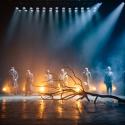
Welcome to the hellmouth. In Jamie Lloyd’s startling 50th anniversary revival, the seething, primal hinterland of Pinter’s domestic conflict is made flesh: the metal cage surrounding an innocuous living room glows a devilish red, sulphur-like smoke belches from the ether, and snatches of Sixties music distort into horror film cacophony. Purists may carp, but it gives a long-revered play a welcome shot of adrenaline.
Lloyd, in concert with Soutra Gilmour (design), George Dennis (sound) and Richard Howell (lighting), has created a memorably cinematic haunted house. At times the bold, expressionistic presentation threatens overkill, but it does vividly illuminate the desperate alienation fuelling the family’s verbal warfare. There’s no safe distancing, rather we’re plunged into the depths of their psychological torment. Pinter’s elliptical exchanges remain riveting, as Lloyd’s additions don’t offer concrete explanations – that would be sacrilege – but a visceral experience of the roiling subtext.
 As fading patriarch Max, Ron Cook is both booming fantasist, spinning yarns about his important past, and helpless widower, hollowed out by the loss of his wife and the nagging knowledge that his possession of her wasn’t total. Gary Kemp’s prodigal son Teddy, returning to his Hackney home after making it big as a philosophy professor in America, is all bluster and condescending blitheness, but his façade is easily punctured by those who’ve known him since birth. It’s the dark mirror of the regression that often results from a familial homecoming.
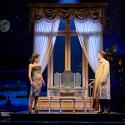
The most striking pair are John Simm and Gemma Chan as insouciant brother Lenny and Teddy’s sphinx-like wife respectively (pictured above with Gary Kemp). Swaggering in spiffy suit and chillingly insouciant when relating his penchant for misogynistic violence, Simm lends the deadpan a razor-sharp precision, horrifying statements queasily framed by a demonic grin. But his mania is revealed by one of Lloyd’s nightmarish breaks, as Lenny furiously wrestles with a clock like it’s a bomb he can’t defuse. Chan, meanwhile, is the icy counterpoint to the hotheaded, pugilistic bullying. While the gender politics of the play remain debatable, here Ruth calculatedly exploits the men’s need for both mother and lover, manipulation flowing both ways. She ascends to the throne that is Max’s armchair with majestic certainty.
 Lloyd also interrogates the traditional notion of masculinity. Keith Allen’s closeted chauffeur Sam proves a match for brutish ex-butcher Max, Simm’s menacing Lenny (pictured left) is disarmed by Ruth’s directness, and Lloyd plays up the absurdity of younger son Joey’s obsession with boxing. In John Macmillan’s reading, Joey is a delusional dullard, easily tamed.
There is breathing space for Pinter’s deconstruction of British niceties, with small talk and exchange of everyday items – a glass of water, a cigar – subversively upended. Lloyd choreographs them into striking tableaux, mapping out the minute but hotly contested power shifts. He’s alert to the play’s revolutionary notion that tradition can stifle and damage rather than cement – “Who can afford to live in the past?” – making it clear that while Ruth fills a ghostly space by taking the place of a lost wife and mother, she leaves her own husband and children bereft.
This is more than a masterful revival – it’s a rebirth. Rather than looking back at a turbulent period, Lloyd has imbued this changing world with fresh, apocalyptic fervour. If that occasionally competes with Pinter’s distinctive hyperrealism, it also honours it, lending the familiar nastiness a mythical power.