

One strain of American music sprang up one evening early in 1950 from a chance encounter at Carnegie Hall, where the New York Philharmonic had played Webern’s Symphony to an audience of all-too-predictably restless patrons. Both bewitched by the Webern and upset at the response, John Cage and Morton Feldman bumped into one another as they left and stayed friends for life: now they have been reunited at a day of concerts within the new music festival hosted by the University of Birmingham.
For John Cage (1982) is a 70th birthday present, one of the concert-length pieces in which Feldman quietly and surely effaces tension from dissonance as if working over a block of marble. Last year I reviewed another one, Triadic Memories. The violin’s rocking motion invites performers to find a tempo natural to them – in this case perhaps a little faster than usual ("fast" and "usual" being very relative terms here), which readily brought to mind Alexander Calder’s mobiles. Two- or three-note gestures are exchanged 11 times, 13 for some equally unpredictable multiple. There are moments of unison, but they are passing, fragile as the bones of a leaf in autumn.
 From the outset, violinist Aisha Orazbayeva and pianist Joseph Houston compelled attention. Houston’s quietly luminescent touch was impressive on its own terms, but Orozbayeva communicated miracles of concentration. She is a self-effacing stage presence, a little shy, with a bow-arm that must have undertaken the equivalent of marathon training, fingers utterly in command of graphene-thin harmonics. I saw her last July, playing German "neo-Romantic" piano trios as part of Tim Parkinson’s excellent series, Music We’d Like To Hear. She could play the phone directory and it would make sense.
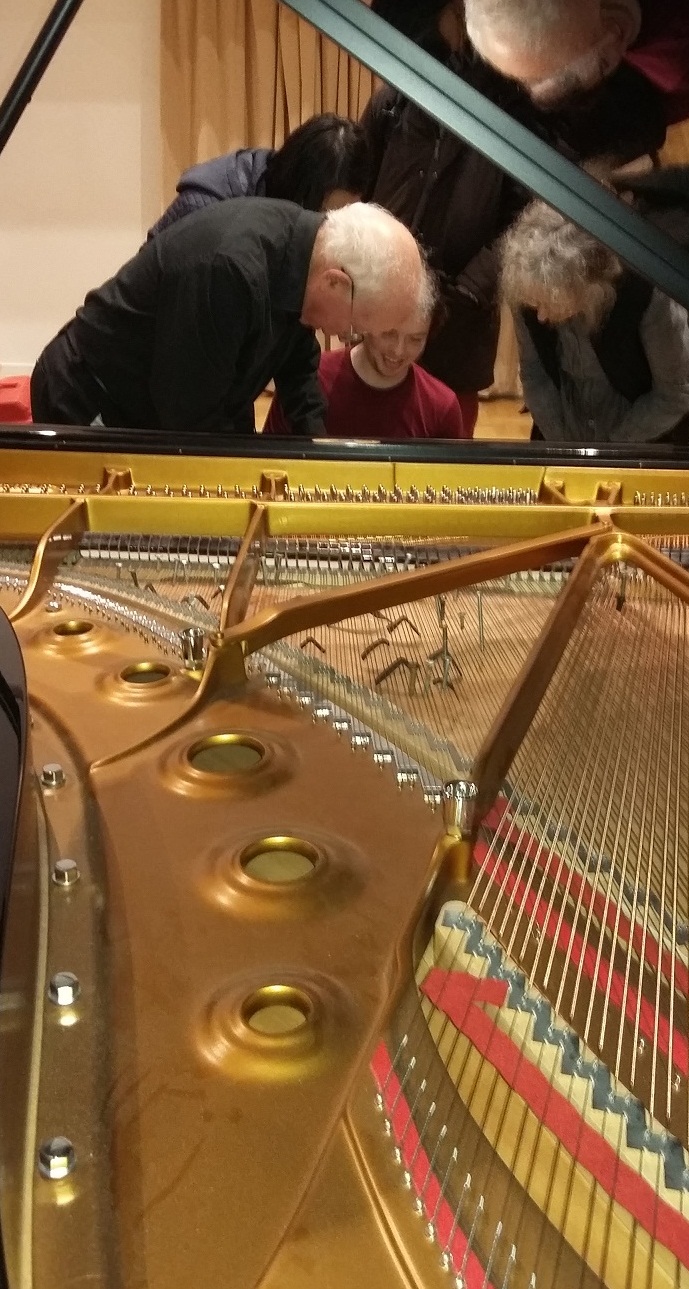
The lunchtime audience for Feldman was scattered across the space of the Elgar Concert Hall, whereas later in the afternoon, Cage’s Sonatas and Interludes for prepared piano (pictured above, the piano being un-prepared by Joel Sachs after the concert) were cramped for room in the upstairs rehearsal studio of the university’s Bramall Music Building, where the tweaks and boinks did not carry far. Sachs’s understated style was made to measure for this modestly domed space, but his introduction left me coveting the resonance of the Chapel of King’s College Cambridge, which is "the perfect acoustic" according to Sachs, who has played them there.
They were Scarlatti sonatas for the 20th century, Sachs remarked, and that’s how he played the Sonatas and Interludes. He did well not to linger in what can become a slow sequence of gestures abstracted by distance. Instead he displayed a scholarly but not pedantic awareness of models and origins, with the prepared piano playing host to a carnival of imported percussion styles as if in some latter-day Great Exhibition: Latin American, boogie-woogie, gamelan. A suite-like construction was imparted to the whole, which began with a grand and hieratic processional, then a busy toccata and stately sarabande. Sachs stopped at Brahms, Broadway and points between for the golden-section climax of the sequence in the Twelfth Sonata and Fourth Interlude. Dotted Baroque rhythms joined Shaker-hymn harmonies for a calm recessional. A tune – Cage could write those, too – drifted tantalisingly on the edge of memory.











