It’s easier to say what Jane Horrocks’s new musical dance-drama isn’t that what it is. Horrocks makes a short speech at the beginning and the end about the mysteries of love, as depicted in her selection of Mancunian heartbreakers from Gang of Four, Joy Division, Buzzcocks and The Smiths, among others. But there’s no narrative, as such, or individual characters, and the songs are only connected with a series of semi-abstract dance routines usually performed at the front of the stage, and often involving Horrocks herself. It’s not a musical or a play, and while it is a kind of covers gig, it seems clear, from the stage design and the dance, that Horrocks is aiming higher than to be a tribute band.
The dance sections involve occasional moments of intimacy, intended presumably to knit the music together into an ambitious psychological tapestry of music and movement. And though on opening night she needed five minutes to warm up, Horrocks is, unsurprisingly, a great stage performer in this context. Her voice has an abrasive power that suits this repertoire very well, and she can, of course, act much better than most professional singers, so there are moments of visceral intensity as she eyeballs the stalls.
Inevitably, the stylistic distinctions between Horrocks’s fairly broad choice of music – from punk to Morrissey – are homogenised somewhat as they are performed by the same musicians consecutively. The band is perhaps too well-mannered to do justice to the more raucous end of their repertoire, such as Buzzcocks’ “What Do I Get”. It’s an enjoyable playlist, though, and younger members of the audience, who didn’t hear this first time round, can approach the show as musical exploration, even if it lacks the necessary window-rattling and filling-loosening volumes.
 There is some very expensive talent on display here: producer Kipper has both Grammys and Emmys to his name; director Aletta Collins was formerly associate artist at the Royal Opera House; while drummer Rat Scabies comes from The Damned, via Lemmy, Joe Strummer, and Eagles of Death Metal. The sound is excellent, and the adapted pieces are performed flawlessly, from a technical point of view. The musicians don’t add much dramatically, however, and could perhaps be placed offstage to leave more room for an expanded dance routine.
Yet, as music writer Paul Morley notes evocatively in the programme note, this was music originally made in a very grimy, pungent Manchester of “grubby pubs and decaying bingo halls”, and the nascent music scene “inspired the creative energy and community pride that pieced the city together again”. The anarchic energy of these bands was deeply rooted in their dismal contemporary locale, but this context is stripped away by both the expensive musical set-up, and the blank white space of the stage.
Horrocks gives moving and intense renditions of some powerful songs
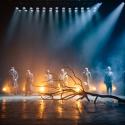
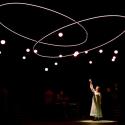
Bunny Christie's set is decorated only with a huge domestic plug and socket (symbolising the meeting place of electric power and domestic security, presumably) and is rather beautiful, but also far too clean to represent anything about 1970s Manchester. At times, there's a touch of self-indulgence about the show – frantic music uprooted from its desperate setting and given a luxurious, sanitising makeover. Cleansing away the Mancunian grime pushes the focus of the drama firmly into the emotional and abstract realm.
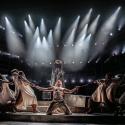
Once the mood is set to febrile introspection, the show requires the dance to establish and develop the emotional continuum between songs, which is effective in parts. Early on, there's some enjoyably animalistic juddering to Gang of Four’s “Anthrax”, with its lyrics about being “like a beetle on its back”, but the intensity isn’t sustained. Like the music, the movement is technically excellent, but in a couple of places becomes too literal, with too much crotch-clutching. There was an opportunity here for grander choreography to have turned this into a thrillingly visceral show. As it is, Horrocks gives moving and intense renditions of some powerful songs, but the whole piece doesn't really become more than a slightly aimless curiosity.