Even by the varied experiences of transferring Shakespeare to another culture, with the attendant revelations that come when an original story is modified to match a world governed by very different priorities, Akira Kurosawa’s Ran is virtually in a class of its own. So it’s a curious thought that associations with King Lear were not in fact at the forefront of the great Japanese director’s mind when he started working in the mid-1970s on what would become his last full-scale epic.
Instead his direct inspiration was the story of a 17th century feudal lord, whose three sons proved themselves exemplars of virtue in striving to protect the interests of their clan, the polar opposite of the bloody division that follows when Ran’s hero Hidetora announces his decision to divide up his kingdom. The device of the three arrows that accompanies the ruler’s initial division of his heritage – individually, they are easily snapped, but prove much more enduring when held together – came from that legend.
Kurosawa’s epic plays out against gloriously grand landscapes
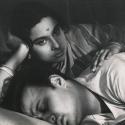
But the Lear parallels inevitably came to the forefront in the film’s development, though the differences that Kurosawa chose to emphasise in his treatment become almost as revealing as what he took more faithfully from Shakespeare. The samurai honour code brings its own extra dimensions that make Hidetora-Lear’s loss of the trappings of power all the more devastating, while Kurosawa’s treatment of the fool (Shinnosuke Ikehata, an actor associated with comedy, has an almost androgynous presence: main picture, with Tatsuya Nakadai as Hidetora) and the blindness theme adds original elements. No less powerful is the final revelation that the scheming of Lady Kaede (Mieko Harada), who becomes a far more demonically prominent figure than any of the Shakespearean husbands, is shown to be in itself revenge for her own family honour slighted a generation earlier.
Another element that distinguishes him from Lear is that Hidetora is, above all, a warlord, one whose power has been achieved through conquest, so that we see in the bloody conflict of his downfall, with its raining arrows which seem to darken the sky and literal streams of blood, the conclusion of that earlier rise to glory. The massed battle scenes are hugely grand as spectacle – no computer special effects here, rather a cast of close on 1,500 extras; they also catch a pivotal change in the history of conflict, when the appearance of firearms for the first time in Japan altered the traditional course of battle whch had been dominated until then by cavalry (parallels with nuclear weapons, and their devastating employment in Japan only decades earlier, were somewhere in Kurosawa’s mind). The closest translation of the original Japanese title is “chaos”, the sense of which grows incrementally despite all our sense of hierarchical rank and strictness of military formation.
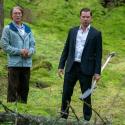
 The main sense in which Ran differs from its Shakespearean prototype must be the sheer sense of scale of its setting (pictured above). If we think of Lear as a dark and stormy play, Kurosawa’s epic – for Ran really does fall into that category – plays out against gloriously grand landscapes that are almost a character in themselves, none more impressive than the enormous rolling mountains with which it opens. The visual spectacle is compounded by the colour-coding of the armies of the three sons into yellow, blue and red (pictured below), as their ranked banners fly against the huge skies.
Shakespeare really was in Kurosawa’s blood, with the former’s sense of philosophical pessimism crossing boundaries of national consciousness as much here as in the director’s (aptly tited) Macbeth adaptation, Throne of Blood. We may be aware of the traditions of Noh theatre in the performances of Tatsuya Nakadai as Hidetora (a role originally intended for Toshiro Mifune) and Harada as Lady Kaede, whose increasingly perverted presence comes to dominate the closing of the film, but they play out in accordance with the rest in the same way that Toru Takemitsu’s Mahler-inspired film score blends with the film’s distinctive natural soundscape.
 The cinematography (Kurosawa typically worked with three cameras) is sometimes almost mind-blowing, full testament to a budget at its time the largest the Japanese film industry had seen (a coproduction partnership with France proved crucial), and this 4K restoration, marking the 30th anniversary of the film’s original release in the UK, accentuates all that visual glory.
No less remarkable then is the thought that, for all his film’s grandeur, Kurosawa may have been really thinking of himself, and his own rather stymied film career when he embarked on what would become one of his undisputed masterpieces (even if it was not generally appreciated as such on its release). "Hidetora is me," the director once mused, leaving us to ponder how much this huge film was inspired by Kurosawa's own life as it was by Shakespeare's drama.