Growing up is a kind of grief: losing the person you once were to embrace the person you will become. That loss can fracture familial relationships, forced to adjust and reform as offspring alter, challenge, question and move away – physically, emotionally or both.
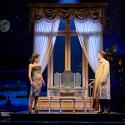
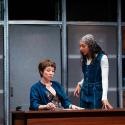
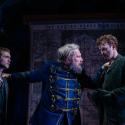
The Adelaide-based family (pictured below) of Andrew Bovell’s shattering Things I Know To Be True, a co-production between Frantic Assembly and the State Theatre Company of South Australia, undergoes a series of these losses. Older daughter Pip (Natalie Casey), gets a job opportunity in Vancouver; Mark (Matthew Barker) has seismic news about his identity; Ben’s (Richard Mylan) work takes him into a world with radically different values; and accidental child Rosie (Kirsty Oswald) attempts independence by backpacking through Europe. Rosie returns early, craving the safety of the familiar chronicled on the titular list, but it soon becomes a source of disillusionment.
 For the UK production (the play premiered in Australia in May), the action remains in Adelaide, though with accents that suggest equivalence with small-town, suburban Britain. Bovell evokes the close-knit, squabbling domesticity with such warmth and understanding that you come to share the family's affection, irritation and heartbreak, and the play rewards its cast with a spotlight moment for each character – including mum Fran (Imogen Stubbs), who has a prickly relationship with her daughters, and dad Bob (Ewan Stewart), who clashes more with his sons.
Fran is particularly hard on Pip, who, we come to realise, echoes both her mother and her grandmother: in a dutiful marriage, yearning for an exit. Yet Fran judges Pip for actually doing it – swapping husband and kids for career and passion. There’s a clear gender double standard, but more pertinent is the way our children’s choices challenge our own. It’s abrasive, knotty and raw – Casey and Stubbs providing the first of many wrenching moments through a textured act of communication.
Excellent, too, is Barker, whose Mark carries the weight of a lifelong secret. Spilling it means risking hurtful censure – as even his hyper-perceptive and seemingly unshockable mother is blindsided by what remains a taboo for her generation – but also joining a new community. Barker finds the authentic messiness of that revelation, exasperated when a glib quip spoils his big speech, defiant even as he weeps.
 The younger siblings have less impactful material, though Oswald’s Rosie has value as the naïve, open-hearted observer who gradually gains more sophisticated knowledge of her family. Ben is the weak link – though there’s some thematic potential to his being caught between two social classes, it’s never demonstrated dramatically, nor are the audience likely to summon much sympathy for a cash-flashing, immoral banker. Mylan gives him a boyish charm, but that only underscores his immaturity – he still expects Mum to clean up his mess.
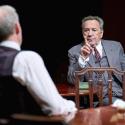
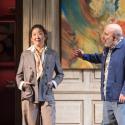
Stewart’s clueless dad is occasionally cartoonish, forever struggling with technology, but effective when Bob lashes out at his children because they’ve dared to become different people, rather than just “better versions” of their parents – that was never an option for him. But Stubbs (pictured above right) has the real firepower in a blistering turn as the no-nonsense matriarch, whose only weakness is stress smoking while problem-solving. Intimate knowledge of her children can turn alarmingly quickly from safety net to weapon, and Stubbs is empathetic towards Fran’s life experience without sugar-coating her cruelty.
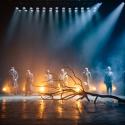
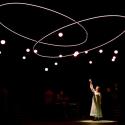
Movement is beautifully and thoughtfully deployed, demonstrating the push-pull bonds of family and its frenetic chaos, with the entrance of each child accompanied by a chair careening into the dinner table. But co-directors Scott Graham and Geordie Brookman deliberately juxtapose that with poetic stillness: Rosie suspended in the heavens as she describes a blissful sexual encounter, Mark standing alone on the shed roof in a downpour, isolated by his secret, or a moment of quiet connection through a Leonard Cohen song. Geoff Cobham’s fluid design superbly demonstrates the symbolic power of the family home (and its flawed Eden of a garden), and Nils Frahm’s piano music adds poignancy.
The production is so exquisitely articulate that occasional overwrought overstatement grates, nudging the piece into melodrama territory. It's best when leavened with Victoria Wood-esque wit: “I want to be bounced about a bit,” says Fran, met with a sighing, “It’s the knees, love” from her husband. There's also an inescapably schematic (and contentious, in post-Brexit Britain) quality to Bovell’s portrait of the two generations, with mum and dad toiling in blue-collar jobs – nursing and working at a car plant respectively – in hopes of a future reward versus the entitled Millennials demanding personal happiness and instant gratification.
Though a tad simplistic, and possibly tackling one "issue" too many, there's still powerful resonance in a drama that explores big ideas through an almost unbearable intimacy. If nothing else, it should inspire audiences to reaffirm those family bonds while there's still time.