Some have responded to the very notion of a musical about cancer as if the idea itself were breaking some unwritten code of what is permissible to put on stage – which seems a bit rich given that the same genre has accommodated pieces about AIDS (Falsettos, now being revived on Broadway), cannibalism (Sweeney Todd) and even singing-dancing pussycats (um, Cats).
At the same time, the National Theatre has among the various strings to its capacious bow an interest in experimenting with musical form: one thinks of London Road, a defining production for the theatre's current artistic director, Rufus Norris, among other titles.
 So the rather startling truth of A Pacifist's Guide to the War on Cancer, a co-production with Complicite Associates which arrives on the South Bank after runs in Manchester and Exeter, is that creator Bryony Kimmings' production only really takes wing once it leaves musical theatre behind. Throughout the first act, the kaleidoscopic portraits of illness on view have to do battle with the overinsistent bass line and too-often awkward lyrics (even Stephen Sondheim might have trouble marrying a word like "compartmentalise" to a melodic line) of a score that wears its heart on a none-too-arresting musical sleeve. But come the far-shorter second act, the piece moves into the communal realm of theatre-as-healing, and I doubt one has to possess a first-hand acquaintanceship with cancer, as I do, to emerge greatly moved.
Wrenched from personal experience, much of A Pacifist's Guide resembles the protest theatre of an earlier era, the difference being that the enemy here – the "war", if you will – isn't Vietnam or apartheid but the ravages wrought by the illness of the title. The programme comes encased in the sort of folder in which you would place a patient's notes on a hospital ward, and contains a remarkable email exchange between Complicite producer Judith Dimant and co-writer and director Kimmings detailing the path whereby Dimant's own cancer diagnosis gave rise to the venture. The connection was only amplified when Kimmings' infant son later fell ill, therein delivering a double-pronged reason for this musical to act as a catharsis that exists to be shared.
Right at the start we hear Kimmings' voice welcoming the audience and addressing the offbeat nature of what lies ahead, though one finds a precedent even here. Referencing in passing the people in the auditorium "who will get cancer in the future", Kimmings at that moment put me in mind of Vanessa Redgrave's baleful remark during the Joan Didion solo play The Year of Magical Thinking that the visitation with death her character was describing was in fact a commonplace: "The details will be different but it will happen to you."
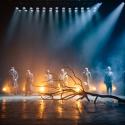
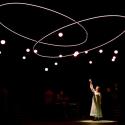
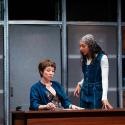
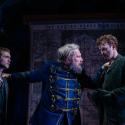
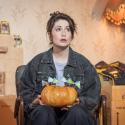
Kimmings' onstage assemblage certainly runs the gamut and includes most notably a version of the author herself in the fearful Emma (Amanda Hadingue, pictured above), who has brought her child to the hospital for tests; a young man, Stephen (Gary Wood, terrific), pondering sperm donation on the one hand and an over-anxious mother on the other; and the unrepentant Mark (Hal Fowler), whose impassioned defense of his right "to smoke my cigarette in peace" and leave the NHS to deal with the medical fallout represents the sort of thing that would send the Daily Mail into apoplexy. Visuals include spongey-looking cancer cells and inflatable tumours that at one point threaten to take over Lucy Osborne's aptly clinical set.
 We get sung paeans to loneliness and requests for a cure, alongside testimonials to and from "the kingdom of the sick" and a group number whose refrain – "fuck this!" – encapsulates the anger (and who in this situation would feel otherwise?) that drives the piece. Still, I for one was relieved after the (unnecessary) interval to find more surprise and nuance to the storytelling: the second act opens with the amplified thrum of an MRI machine as if to remind us that hospitals can be scarily quiet but also forbiddingly clamorous, in turn. (The excellent sound designer is Lewis Gibson.)
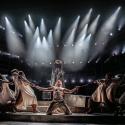
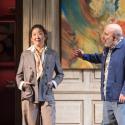
And as the music falls away – a plaintive solo for the ever-beautiful Golda Rosheuvel (pictured above) excepted – we find instead a call-and-response that turns the Dorfman into a communal centre of healing that may prove too embarrassing for some playgoers but that takes the show to an entirely different plane. Suddenly, real voices come out of the (mimed) mouths of the actors, at around the same time that the audience is invited to share the names of those they have loved and lost. And before you know it, an event birthed in rage at the premature dying of the light ends on a note of solidarity that allows an audience of individuals to converge. We're in this life with and for one another – until we're not.