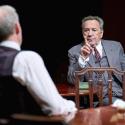
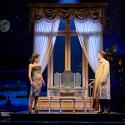
The signs were there early in Glenda Jackson's career that she would one day have what it takes to "ascend the Everest" (as the cliché has it) of Lear. So powerful was her performance as Ophelia in Peter Hall's production of Hamlet in 1965 that there was talk afterwards of her being cast as the prince himself. Two years later she was another disturbed woman playing Charlotte Corday unforgettably whipping Marat with her hair in The Marat/Sade. Uncompromising directness, a febrile, earthy authority and a strong, resonant, slightly nasal voice characterised these performances.
She went on to others, including Vittoria in The White Devil in 1976 and Phedra in 1984 at the Old Vic where she now owns the stage as Lear. She didn't seem to bother with anything as trivial as prettiness when she was young, although she was glamorous enough in her Oscar-winning performances in Women in Love and A Touch of Class. Now, returning to the stage after a quarter of a century, her pale, lined face, skull-hugging hair and slight, androgynous frame are a positive advantage. And that voice rings out clearly still.
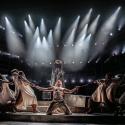
 Between times, from 1992 to 2015, as a Labour MP, Jackson gave the House of Commons the benefit of her toughness in speeches that invariably spoke for the dispossessed in society, notably the homeless. When as Lear she bellows "O reason not the need" with such heartfelt ferocity, she might once again be addressing Iain Duncan Smith across the chamber. King Lear was, in that sense, an obvious choice for her, but its physical demands and the stamina required argue tremendous courage for a woman of her years; she is, unusually for the actor playing Lear, exactly the age of the character: 80. Often dwarfed by those around her she is, nevertheless, "every inch a king" and, as Lear loses his grip on reality and in the scenes with the blinded Gloucester and the body of Cordelia she is very moving. Her daring has paid off.
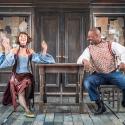
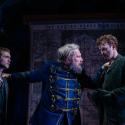
But, important as the title role is, King Lear requires several other strong performances and Deborah Warner's Brechtian-style production doesn't deliver in all cases. On the positive side, Rhys Ifans's Fool (pictured above) is the best I've seen. Sadly, intelligently truth-telling, physically daring (including bravely swallowing a raw egg), mischievous – he adlibs and flirts with the audience – he is genuinely funny. Dressed in a mangled version of a Superman suit (and, for his prophecy, a scary clown mask), causing a deluge of beer cans to tumble from Goneril's fridge, he brings a splash of colour to proceedings in a mainly monochrome world. There is a genuine bond of understanding and affection between this Fool and his master.
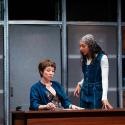
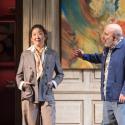
Simon Manyonda as Edmund, Harry Melling as Edgar and Sargon Yelda as Kent all provide strong support, and Morfydd Clark is an independent-minded, clear-spoken Cordelia. As Goneril and Regan, however, Celia Imrie and Jane Horrocks (below, with Danny Webb as Cornwell) are rather too close to being the wicked sisters, sometimes to the point of caricature, and Karl Johnson, although touching as Gloucester, is not always easy to hear.
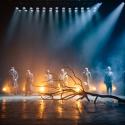
 The premise of the production is that we must acknowledge at all times that we are in a theatre, possibly even a rehearsal: each scene is labelled Act I, scene I etc, and cast members wander on stage – which is still being swept – before the action begins. Costumes are mostly modern casual gear, sometimes with a nod to character: Jane Horrocks as sex-mad Regan wears skinny jeans and spike heels, for instance. There are oddly risible moments, most surprisingly in the removal of Gloucester's second eye. Later Goneril dons Marigolds to mop up Regan's vomit. And some odd choices: why does Edmund deliver the "Bastard" speech while skipping?
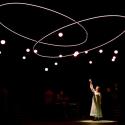
The soundscape occasionally makes speech difficult to hear. The storm (for which Warner has said the actors are, of necessity, miked) is spectacular, however, with its effects of lashing rain, thunder and lightning. This is an occasion where the epic qualities of the stage with its design – by Warner herself and Jean Kalman – of monumental, moveable white flats suit the production well. At other times, the actors seem diminished and a more intimate space might have allowed better scope for detail and improved audibility.
10 GREAT KING LEARS
Greg Hicks, RSC. Hicks occupies the part with brisk and inventive intensity.
Derek Jacobi, Donmar Warehouse. A thrilling chamber version, though even at 72 Jacobi still seems too spry
Grigori Kozintsev, 1971 Russian film version. Truly apocalyptic masterpiece, stunningly performed
Tatsuya Nakadai, Kurosawa's Ran. Lear-inspired epic of the futility of war
Jonathan Pryce, Almeida Theatre. Pryce heads a disturbingly dysfunctional family in a compelling production of Shakespeare's tragedy
Simon Russell Beale, National Theatre. Russell Beale's Lear budges up to make room for Mendes's vision
Barrie Rutter, Northern Broadsides. Jonathan Miller's vivid production puts Lear in a Yorkshire accent
Antony Sher, RSC. Sher runs the full delivery gamut in Gregory Doran's distinguished production
John Shrapnel, Tobacco Factory. A traditional Lear triumphs in the heat of Bristol's alchemical vessel
Aleh Sidorchik, Shakespeare's Globe. Belarus Free Theatre stages Lear as post-Soviet Oedipal X-Factor extravaganza