The straw hat is surely the season’s requisite headgear for great actors embarking on their valedictory screen performances. It was there on the venerable Harry Dean Stanton’s head through much of Lucky, and the great John Hurt makes it his own in Eric Styles’ That Good Night, his last lead film role (his cameo in espionage thriller Damascus Cover hardly counts). As its title, drawn from Dylan Thomas’s famous poem about death, suggests, the whiff of mortality is strong, and so is the sense of a script creaking, dramatic impact sustained principally by the charisma of a master.
“The horizon recedes as we go through life… then a day comes when it stoops receding,” Hurt gives us in opening voice-over, all that old flushness of voice still there, its cadences glorious. He plays Ralph Maitland, a once-eminent British writer now living out his days in halcyon, albeit grumpy style in a perfect Portugese landscape. It seems a practically blessed existence, in the loving care of younger wife Anna (Sofia Helin, unrecognisable from The Bridge), until a hospital diagnosis brings “the ultimate deadline” into his world.
The immaculately urbane Dance spars with the cantankerous Hurt
Selfishness has clearly long been second nature for Ralph, so his determination to die according to his own wishes comes as little surprise. An impetuously urgent call to semi-estranged son Michael (Max Brown) brings up various ghosts, hardly in any healing manner, and results in an ugly family row when Maitland-fils – he’s a scriptwriter too, though of admitted schlock – arrives in the company of a girlfriend (Erin Richards), to whom Hurt’s character can’t resist being gratuitously rude. No calm passing for this “terrible old goat”, then.
And that’s despite Ralph’s having looked into options for euthanasia on the sly, which precipitates the appearance of an elegantly clad stranger – representing a shadowy organisation known only as “the Society”, he has no name, credited only as “the Visitor” – onto the scene. Played by Charles Dance in trademark white linen, the visitor’s responsibility seems to be to assess his client’s wishes. He only gets three briefish scenes, but they give That Good Night much of its brightness, as the immaculately urbane Dance spars with the cantankerous Hurt (pictured below).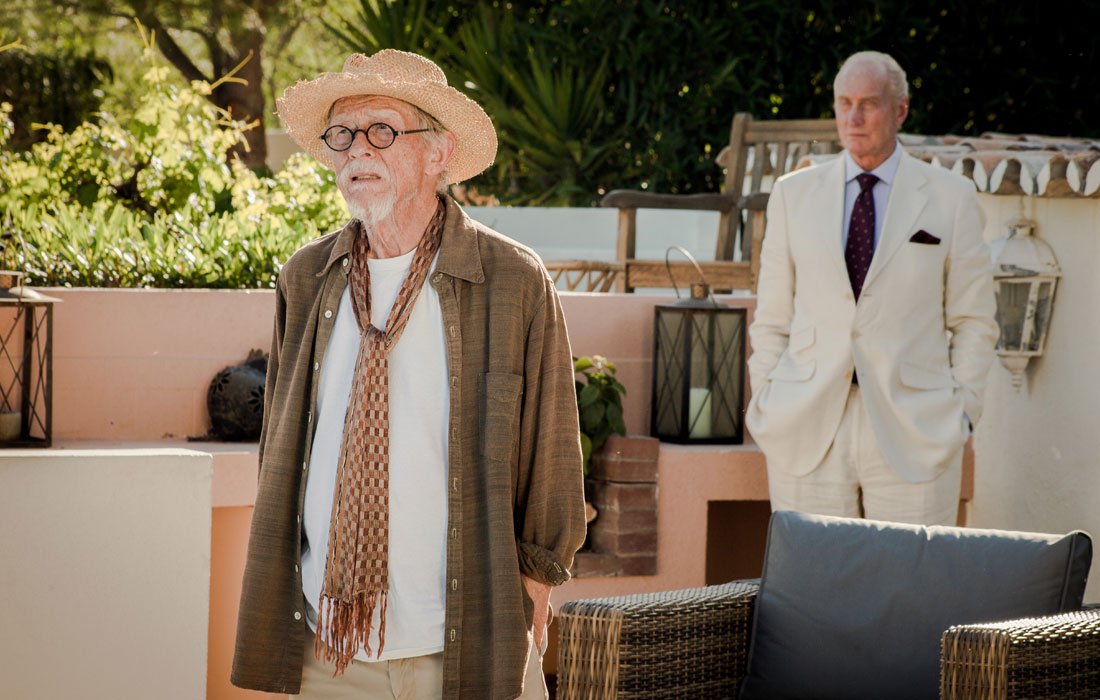 There’s at least one nice surprise in that interaction, which is more than can be said of most of the rest of the proceedings. Father-and-son interaction, along the lines of Michael’s accusation, “You were always generous with money, never with affection”, is distinctly formulaic, with Brown limited to playing foil to his father, the mere fact that they are still in contact at all something a surprise. Coupled with Styles’ casually loping directorial style, the female roles come across as little more than cyphers, Helin in particular displaying a blissed-out serenity that’s a million miles from the complexities of The Bridge. Barely a brow furrowed here, in fact.
The irony is that That Good Night treats its subject with, to adapt the Dylan Thomas poem again, far too much gentleness, its sense of whimsy far more pronounced than any hint of rage. Styles has adapted the 1996 NJ Crisp play that was a vehicle for Donald Sinden, adding a tangible luxury of cinematic location that certainly hasn’t toughened the piece up, while composer Guy Farley provides a score that is soupily insistent.
And yet… Hurt’s death at the beginning of this year can’t help giving bravura to his performance, playing as he was in the full knowledge of his own demise (Hurt’s own diagnosis came in 2015). That Good Night hardly delivers what its title appears to offer, but Hurt’s closing recitation of the lines of the Thomas poem is reason enough to see it through to its far-from-bitter end.
Overleaf: watch the preview for That Good Night