Fred Schepisi’s The Chant of Jimmie Blacksmith (1978) was the Australian New Wave film that most rigorously confronted the cataclysmic effect of British and Irish colonisation on the country’s Aboriginal people. It helped pave the way for such 21st century racial dramas as indigenous director Warwick Thornton’s Samson and Delilah and Sweet Country and Jennifer Kent’s The Nightingale.
Schepisi adapted it from Thomas Keneally’s 1972 novel, which looked beyond the Aboriginal genocide to the tragedy of attempted black assimilation in the whitefellas’ culture. Jimmie was based by Keneally on Jimmy Governor, a farm fencer born to an Aboriginal father and a half-white mother in New South Wales in 1875. Governor and a fellow Aborigine worker, Jacky Underwood, massacred four white women and a boy in 1900 for abusing Governor and his white teenage wife, Ethel; the fugitives carried out four more revenge killings before they were captured. Governor and Underwood were hung in January 1901; Ethel gave birth to her and Governor’s second child after his death.
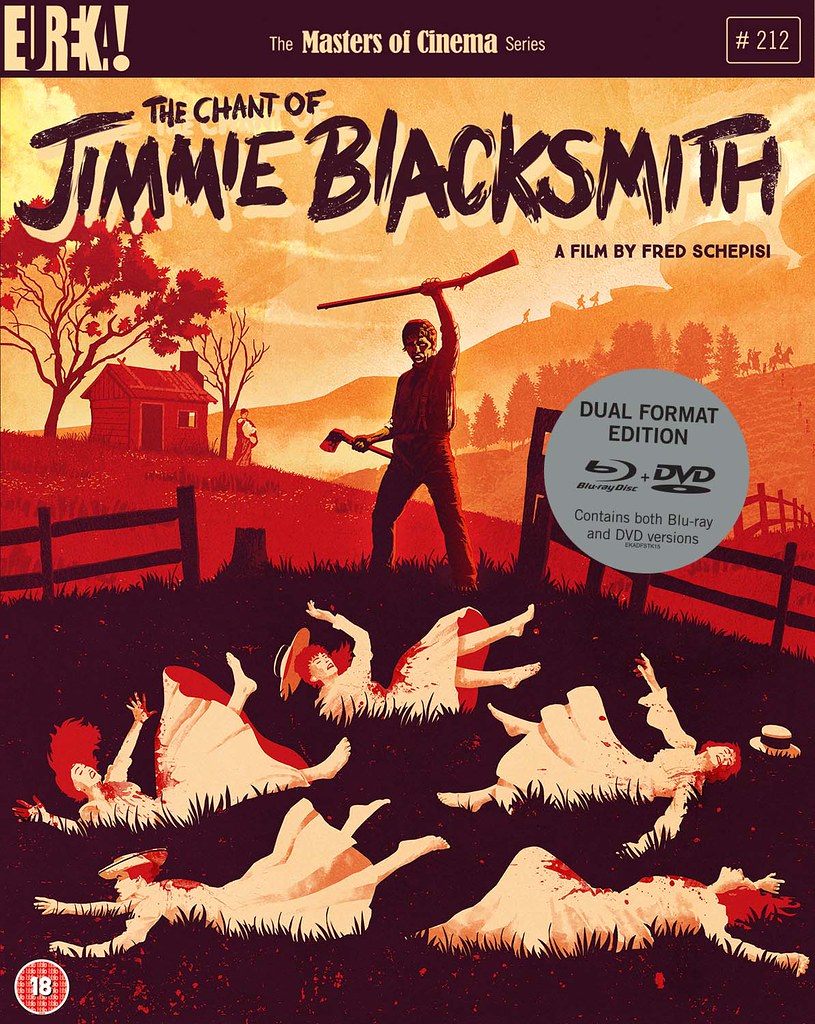 The Chant of Jimmie Blacksmith, which depicts most of these events, makes a powerful case that Jimmie (Tommy Lewis), a well-meaning and ambitious half-white blackfella, is a victim of his begetting: male pioneers' sexual predation on “gins” (Aborigine women) which was endemic in the colony. Raised by a punitive white clergyman (Jack Thompson) and his wife, Jimmie is cut off from his tribe and consistently cheated by the Scottish and Irish landowners who hire him.
He works briefly for a vicious policeman (Ray Barrett) whose outrages include raping and murdering a black jailbird who was once Jimmie's friend. When Jimmie’s white wife Gilda (Angela Punch) bears an all-white child, he accepts it as his own but fears that he will be rejected later. The white women who helped deliver the baby implore Gilda to leave Jimmie; they’re among those he spontaneously kills when he’s exploited one time too many.
The movie’s intricate mise-en-scéne reflects Jimmie’s alienation from his ancestral land and his sense of entrapment indoors. Schepisi’s regular cinematographer Ian Baker shot much of the film in a near-anthropological style. That it now seems visually dated scarcely detracts from its historical significance. The music cues are awful, some of the staging and acting crude. But Bryan Brown is fine in a small part as a mouthy bloke – and the handsome, charismatic Lewis excels in the lead role.
In his late teens when the film was made, Tommy Lewis (or Tom E Lewis), was Balang TE Lewis, who became a prolific actor, musician and champion of Aboriginal traditions; he died suddenly at 59 in May 2018. His humble on-camera testimony in this dual format disc’s extras (recorded in 2008 and issued with previous releases) is a compelling reason to own it.
Lewis's life wasn't as brutal as Jimmie Blacksmith’s, but there were clear echoes.The son of a Welshman and a Murrungun woman, he talks hauntingly about the early deaths of many of his Aborigine friends from alcoholism – a theme in the movie – and discusses his own battles with it. Mirthfully, he describes how he just about refrained from using violence against whites who suspected him of kidnapping the little blonde girl he used to carry on his shoulders: she was his daughter. Among career interviews with Schepisi and Baker and other featurettes, Lewis’s reminiscences are the stuff of anguish and resistance. He carried a banner for all the Jimmies.