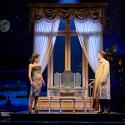
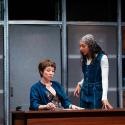
Shuck 'n' Jive is an hour-long two-hander about writing a play about being black in a white industry. The industry? Theatre. Performance. The stage.
Simone (played by Olivia Onyehara), an opera singer, is from Lincolnshire. Cassi (played by Tanisha Spring), an actress, is from south London (so south, in fact, it's the part of Croydon where you can see countryside). But hold on. Is the play really about what it says it is? On the one hand, yes: the anecdotes come thick and fast. Meta-pastiche minstrel shows take over the auditions which Cassi and Simone attend. Hamilton and Porgy and Bess are conflated as "the black people" musicals. A producer writes that their production is "particularly keen to cast people from a BAME background". The ringing response? "BAME is not a background!". An unsubstantiated rumour goes round drama class of drug dealing. Simone points out that the character Cassi found inspiration from in kids TV show Playdays was a black, female puppet literally manipulated by a white guy.
It would be sick if it wasn't so funny. And it's only funny because the theatre is not an actual audition room. But maybe for writers Cassiopeia Berkeley-Agyepong and Simone Ibbett-Brown, it was. Likewise for Onyehara and Spring. The brutal bits when they come are remorseless. A man perves on Cassi in a café and ends by shouting abuse when she leaves because of his racist remarks. Simone acquiesces over the phone to a pushy producer's demand that they get a writer (male, white, straight, cis, probably reasonably well-off) on board to rewrite the play because she fears for her job prospects. Cassi pulls her up but they're both, in different ways, guilty of cleaving to the system that would otherwise spit them out.
However, whether these experiences are drawn from life or not is beside the point. They're horrifyingly believable. "Why are we doing this?" asks Simone. "Because our lives are hilarious," replies Cassi. Paired with the conceit that "It's a play about our lives. The story writes itself," what makes it shine is that – like every other aspect of the play – it's quickly exploded: "I hate plays that are about what they're about."
In a fine balance between comedy and horror, various degrees of queasy nausea inform the performance. The combination is variably successful, but both informative and affecting – because what's really at stake is actually their friendship. For a play that is no light touch in its meta appeal to a woke, millennial audience – moreover, one that is in with the thespy in-jokes – this is no mean feat. Political questions get personal, and the crux – their different ways of approaching and addressing the biases, self-interest and gross inequalities they encounter in the theatrical industry – become a point of painful contention. (Obviously, this is also discussed in a scene about what the crux of the play needs to be).
Yet in the face of both overt and not-so-overt bias it's impossible to disagree with either Cassi's to-the-point approach or Simone's more emollient one. What is the best thing to do when someone is shouting they'll rape you with bleach until you're white enough to be presentable to their mother? How to make sense of the fact that as a performer, whose career success is pegged in various ways to how they look and who they seem to be, can have a life so mixed up as to be "paid weekly and live in a rented flat" but have played croquet the previous day. When dissonance is so great that it's the responsibility of the victim not to escalate, or the low-waged to keep up the pretence, are there any definite answers?
The play is a mixture of skits, set pieces, music, and narrative scenes. It's deep into the meta. Sometimes it's glib, sometimes there's almost a surfeit of feeling. It can be preachy and it's often over-earnest. But it undercuts itself remorselessly. So is it any of those things? Slightly yes and slightly no (or should that be know?). It's not a play for everyone. It's also far from perfect. But these are two assured, clever and emotionally adept playwright-performers making their mark on a scene that should be paying attention.
- Shuck 'n' Jive is at the Soho Thetare until 26 October
- Read more theatre reviews on theartsdesk