“Talking cures and exploring the darkness of men’s souls – are you sure this is a career for a gentleman?” This is Vienna, 1906. Freud is exerting an influence, to the disapproval of many, including the father of cool-as-a-cucumber Max Liebermann (Matthew Beard).
Max, a British-Jewish doctor, is a Freud acolyte. He is also working in the neurology department of a Viennese hospital where electro-convulsive therapy is still the order of the day. “We don’t change our working practices every time some Jewish doctor publishes a book,” scoffs the hospital director (anti-Semitism lurks everywhere in this fast-growing, ethnically mixed city; Hitler’s fateful five-year Vienna sojourn is about to start).
In order to understand the criminal mind, Max is shadowing detective inspector Oskar Rheinhardt (Juergen Maurer). Of course, Max’s psychoanalytic insights and newfangled ideas about “profiling” are vastly successful. He develops an annoying habit of saying, “Welcome to the case, Inspector,” whenever his cunning Sherlock-Holmes type psycho-sleuthing starts to show results. Rheinhardt can’t stand Max at first but by the end they’re thick as thieves, making unfunny jokes about their hats.
Vienna Blood, written by Steve Thompson (Sherlock, Deep State) and directed by Robert Dornhelm and Umut Dag, has a British and central European cast and is based on Frank Tallis’s best-selling Liebermann novels. You feel that it should be interesting, given the era, the setting and the references to real-life Freud cases such as the Wolfman, but it’s a struggle to engage with, never escaping its costume-drama shackles amid a hammy melée of accents. Shot on location in Vienna, the bustling street scenes, elegant cafés and Opera House vistas nevertheless have an ersatz, stagey quality that’s hard to get excited about. The boxes are ticked: here’s a Klimt frieze and a woman collapsing in hysterics (soon to be helped by Max and the talking cure), there’s a Ferris wheel reference to The Third Man; here are some lace-petticoat-clad ladies of the night lying in pools of blood, there’s a clairvoyant who fleeces her clients, though, as the inspector shrewdly observes, ahead of his time, “There is no difference between your Freudian cure and these poor souls spilling their grief to a charlatan like her.”
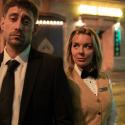
To be fair, the first episode, which deals with the murdered clairvoyant (“a hoax or witchcraft?”) is perhaps the weakest. Max’s tediously conventional fiancé Clara is much in evidence (Luise von Finkh, pictured above with Max and Oskar). We know their relationship is doomed – “This is not how a man in love behaves,” remarks Max’s sister (Charlene McKenna) several times – as well-meaning Clara is no match for the superciliously brilliant, work-obsessed Max, even though she knows all the right people.
Things hot up a bit in the second episode, where there’s a lush Magic Flute set-design crime with a traumatised son at its heart, and the anti-Semitic thread is developed further. An anti-immigrant Aryan brotherhood is on the loose, making statements about blood purification, and Max’s father (Conleth Hill, fresh from playing Superintendant O’Kelly in Dublin Murders) is forced to choose between his immigrant workforce and investment from an anti-Semitic source (“We decide who’s a Jew and who’s not,” says his useful steel magnate acquaintance cosily – more or less a quote from Karl Lueger, Vienna’s populist leader of the Christian Socialist party at the time). And the third episode takes us to a military academy, where initiation rites and murderous bullying are on the rise.
Matthew Beard’s impressively imperturbable performance does start to grow on you, but there’s an inauthentic, bloodless air to Vienna Blood, and its various parts never quite add up to an emotional whole.