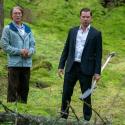
“Films are about the mystery of fate or the mystery of faith,” proclaims director William Friedkin in Alexandre O. Philippe’s latest documentary, Leap of Faith. At 84 years old, Friedkin proves himself to be a master of storytelling, not only behind the camera but in front of it, spiritedly discussing the genesis of his horror masterpiece with Philippe.
Unlike the Swiss filmmaker’s previous works 78/52, which tackled the shower scene in Pyscho, or Memory: The Origins of Alien, Leap of Faith consists mainly of a single talking-head interview with Friedkin. It could feel like a DVD extra, or a masterclass series, but thanks to Friedkin’s captivating presence and Philippe’s use of archive footage, the documentary is a much richer experience.

This is a pleasant, easy watch in which Friedkin systematically, but also candidly, discusses the film's influences, casting and scoring. Most interesting is his perspective on the religious themes in the adaptation of his friend William Blatty’s book that Friedkin’s film was based on.
It’s fair to say that, in the nearly fifty years since its release, the film has had legions of fans. Academics, critics and more have pored over its material, ranging from the infamous ‘curses’ during production, to the sensational reactions upon the film’s release (on this subject, it’s also worth seeing Mark Kermode’s 1998 documentary, Fear of God, currently available on iPlayer). What makes Philippe’s documentary captivating is hearing about the film straight from the source. Friedkin, although proud of the work and its legacy, has no hesitation admitting the problems he has with it, including the death of Karras, which he still believes is problematic (which incidentally, is where the title of the documentary comes from).
Some of what Friedkin says has been heard before: firing a gun to elicit reactions of shock, punching the (now disgraced) real priest Fr William O’Malley, or the way Mercedes McCambridge gargled eggs, knocked back scotch (when she was a reformed alcoholic) and smoked cigarettes to create the terrifying voice of the demon Pazau. These are now the stuff of filmmaking legend, and it’s entertaining to witness Friedkin reflect on getting away with the unconventional methods that would likely see him end up in court today.
However, there are also more revealing moments. There’s the lesser-known story of Friedkin’s encounter with composer Bernard Herman who, having recently left America after falling out with Hitchcock, was to "save" The Exorcist with a score that Friedkin subsequently rejected. It’s an incident that Friedkin describes as one of ‘the worst disappointments of my life’. More revelatory is the claim that Blatty offered to forfeit any percentages on the film if he could have played Father Karras. We have to take what Friedkin says in good faith, seeing as Blatty passed away in 2017.
If we treat Leap of Faith merely as an arresting "making of", then Philippe’s approach appears negligent. But this underestimates Philippe as a filmmaker and critic. The production history is a framework that Philippe uses to explore not just Friedkin’s methods, but also his aesthetic, religious and philosophical beliefs. Friedkin gives as much time to the subject of fate as he does faith, earnestly suggesting that it was the will of "The Movie God" that led him to make the feature. If this sounds grandiose, or delusional, Friedkin comes across as neither. Rather he humbly states that we live in a state of perpetual ignorance, and the ambiguity that runs though his films is there because it reflects the nature of life, or for that matter, death.
Indeed, Leap of Faith is much more than a "making of" feature. Instead, it is a deep dive into Friedkin’s philosophical and aesthetic outlook, reflecting on grand questions of faith and fate. It’s so enjoyable, it could have been twice as long.