

The youthful New Zealand-born conductor Gemma New and British cellist Laura van der Heijden between them set the Hallé quite a challenge at this concert.
The music was all written in the past 75 years or so – by classical measures that’s pretty recent – and not by any means standard repertoire. And, written for large orchestra in complex scoring in each case, it made considerable demands. They rose to almost all of them with passion and skill and won a generous reception for their efforts.
The newest was first: Icarus, by Lera Auerbach (written this century). It’s based on the famous story of the high-flyer who flew too high, and the composer invites listeners to let the music “take you wherever it takes you”. Is that to say there’s something programmatic in it? Maybe … I could hear it as a series of events (take-off, floating, crisis, crash, mourning, elegy), but I suspect that was mainly because Gemma New brought it to life as a series of bite-size chunks: often a good way to make sense of unfamiliar music and the more welcome for that. The orchestra gave her playing of precision and vivid colours.
Walton’s Cello Concerto is another thing entirely, subtly constructed with the illusion of rhapsodic flow coming from taut, theme-based construction. As ever with cello concertos, the matter of balance looms large, especially with an orchestra as large as Walton uses (and the Hallé had 60 strings to offer). The textures are cleverly designed to deal with this, as they often play piquantly, as much in rests as richness, and by the third movement the backcloth to Laura van der Heijden’s solo was ultra-discreet. 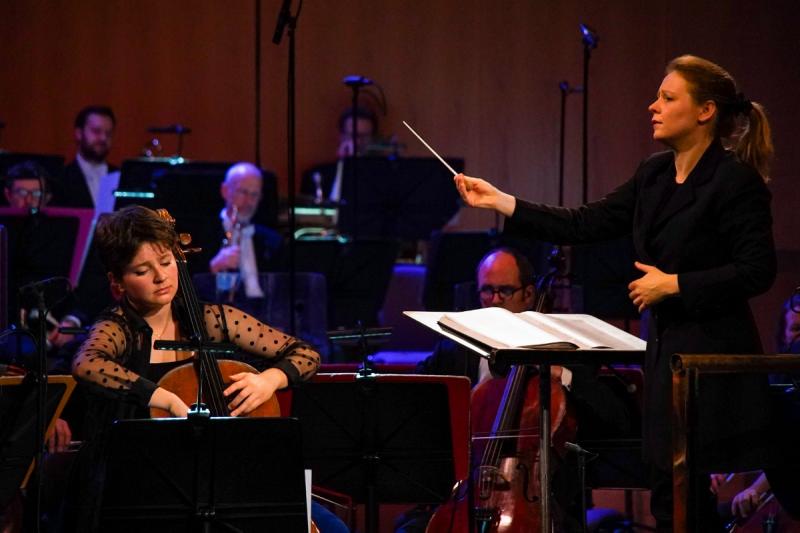 Van der Heijden herself (pictured above with orchestra and conductor last night) does not often go for in-yer-face expression, but her playing has a lovely soulful tone that suits this piece perfectly. The opening movement came across quite sleepily nostalgic, and the hyperactive scherzo style middle one had a fairy-like quality in the solo (and lightness and grace in the adroit orchestral contributions). But the first solo variation of the third movement (one of two that are like cadenzas in effect) showed that she can deliver a big sound and masses of attack when required. It was playing of remarkable resource and range.
Gemma New brought her sense of episode to those variations, with the same clarity as she had in the Auerbach piece, and the concerto’s ending, as if with all passion spent and resignation looming large, was very beautifully done by both soloist and orchestra.
Aaron Copland’s Third Symphony brought the opportunity to unleash the potential of the forces onstage. Written for Koussevitzky and the Boston Symphony, it captures post-Second World War relief and optimism – and its most memorable theme is that of Fanfare for the Common Man, which Copland had written a couple of years before and which he uses extensively in his “grand manner” (his words) finale.
Can you get an extended sonata movement out of that tune, and indeed build a whole symphony out of the desire to build up to it? Well, the answer is probably a qualified yes, and it’s been hailed (by Koussevitzky: who else?) as “the greatest American symphony”. Gemma new made a very good case for it, and Copland’s trademark open textures, downright diatonic harmonies, wide intervals, honkytonk hoedown rhythms, bright-eyed canons and tolling pedals are all there.
At times it takes on the characteristics of his ballet scores (and there’s nothing wrong with dancy tunes in a symphony), but the third movement is deeper and was given fine expression here, with eloquent, near-anguished, solo playing by guest leader Hannah Perowne.
Perhaps that finale did not have the razor sharpness or panache that I imagine the Boston Symphony might have brought to it, but it was a very worthy embodiment of the grand manner.
- The concerto performance is repeated in an otherwise different programme by the same artists at King George's Hall, Blackburn, tonight and Leeds Town Hall on Saturday
- Read more classical reviews on theartsdesk











